

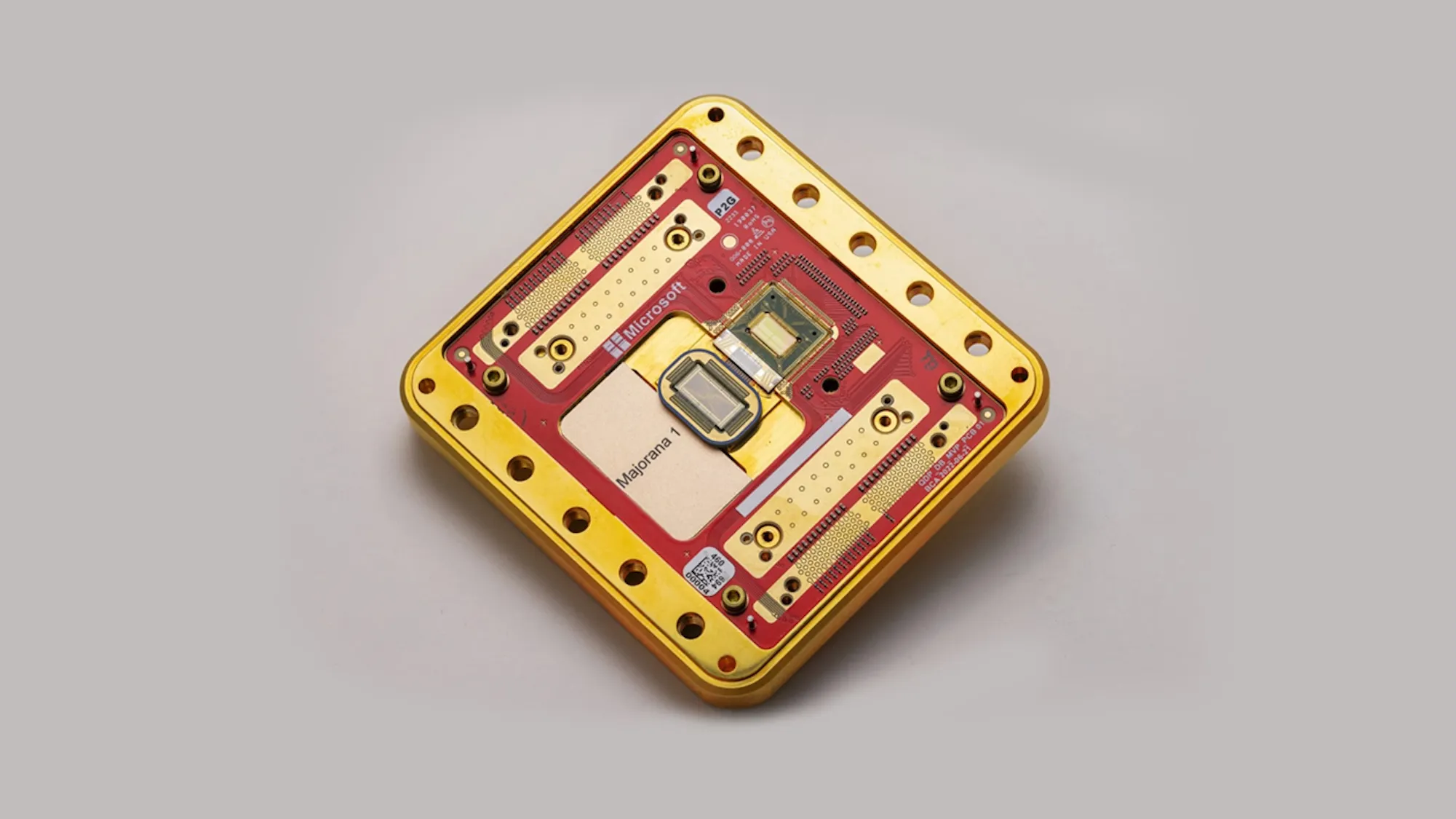
Microsoft has announced the creation of the Majorana chip, a potential game-changer in the world of computing. The company claims this chip uses a novel approach to quantum computing, leveraging a unique state of matter to achieve unprecedented processing power. This development could mark a significant leap forward, potentially dwarfing the capabilities of even the most powerful supercomputers today.
The Majorana chip is based on the Majorana fermion, a quasiparticle first theorized in 1937 by Italian physicist Ettore Majorana. Unlike ordinary particles, which have distinct antiparticles, the Majorana fermion is its own antiparticle. This unique property makes it a promising candidate for building stable and fault-tolerant quantum computers. Microsoft’s research team has reportedly found a way to create and control these Majorana fermions, a crucial step in harnessing their potential for computation.
Traditional computers store and process information as bits, representing either 0 or 1. Quantum computers, on the other hand, use quantum bits, or qubits. Qubits can exist in a superposition of both 0 and 1 simultaneously, allowing quantum computers to perform certain calculations exponentially faster than classical computers. 1 The challenge, however, has been maintaining the stability of qubits, which are highly susceptible to noise and errors. Microsoft believes the Majorana fermion offers a solution to this problem.
By encoding quantum information in Majorana fermions, which are inherently more stable than other types of qubits, the Majorana chip aims to overcome the decoherence issues that have plagued previous quantum computing efforts. Decoherence refers to the loss of quantum information due to interactions with the environment. The increased stability offered by Majorana fermions could pave the way for building larger and more reliable quantum computers.
While the details of the chip’s architecture and performance remain somewhat limited, Microsoft’s announcement suggests a significant advancement. The company has been researching topological quantum computing, a field that focuses on using exotic states of matter to create more robust qubits. The Majorana chip appears to be a culmination of this research, potentially representing a major breakthrough in the field.
The implications of this development are far-reaching. Quantum computers based on the Majorana chip could revolutionize various fields, including medicine, materials science, and artificial intelligence. Drug discovery could be accelerated by simulating molecular interactions with unprecedented accuracy. New materials with unique properties could be designed and tested virtually. Complex optimization problems, such as logistics and financial modeling, could be solved much more efficiently.
However, challenges remain. Building and scaling quantum computers is an incredibly complex undertaking. Even with the stability offered by Majorana fermions, controlling and manipulating these quasiparticles is a delicate process. Microsoft’s research team will need to overcome numerous engineering hurdles to create a practical and scalable quantum computer.
The development of the Majorana chip also raises questions about the future of computing. While quantum computers are not meant to replace classical computers entirely, they are expected to excel at specific tasks that are intractable for even the most powerful supercomputers today. This could lead to a hybrid computing model, where classical and quantum computers work together to solve complex problems.
The announcement of the Majorana chip has generated excitement within the scientific community. Many experts believe that quantum computing is on the cusp of a major breakthrough, and Microsoft’s development could be a crucial step in that direction. However, it is important to remember that quantum computing is still a relatively young field, and there are many challenges that lie ahead.
Microsoft has not yet disclosed a timeline for when the Majorana chip might be available for commercial use. The company is likely to continue its research and development efforts, focusing on improving the chip’s performance and scalability. In the meantime, the scientific community will be closely watching this development, eager to see the full potential of the Majorana chip and its impact on the future of computing.
The company’s focus on topological quantum computing, with its inherent stability, suggests a long-term vision for building fault-tolerant quantum computers. This approach could ultimately lead to the creation of quantum computers that are not only powerful but also reliable, paving the way for a new era of scientific discovery and technological advancement.