

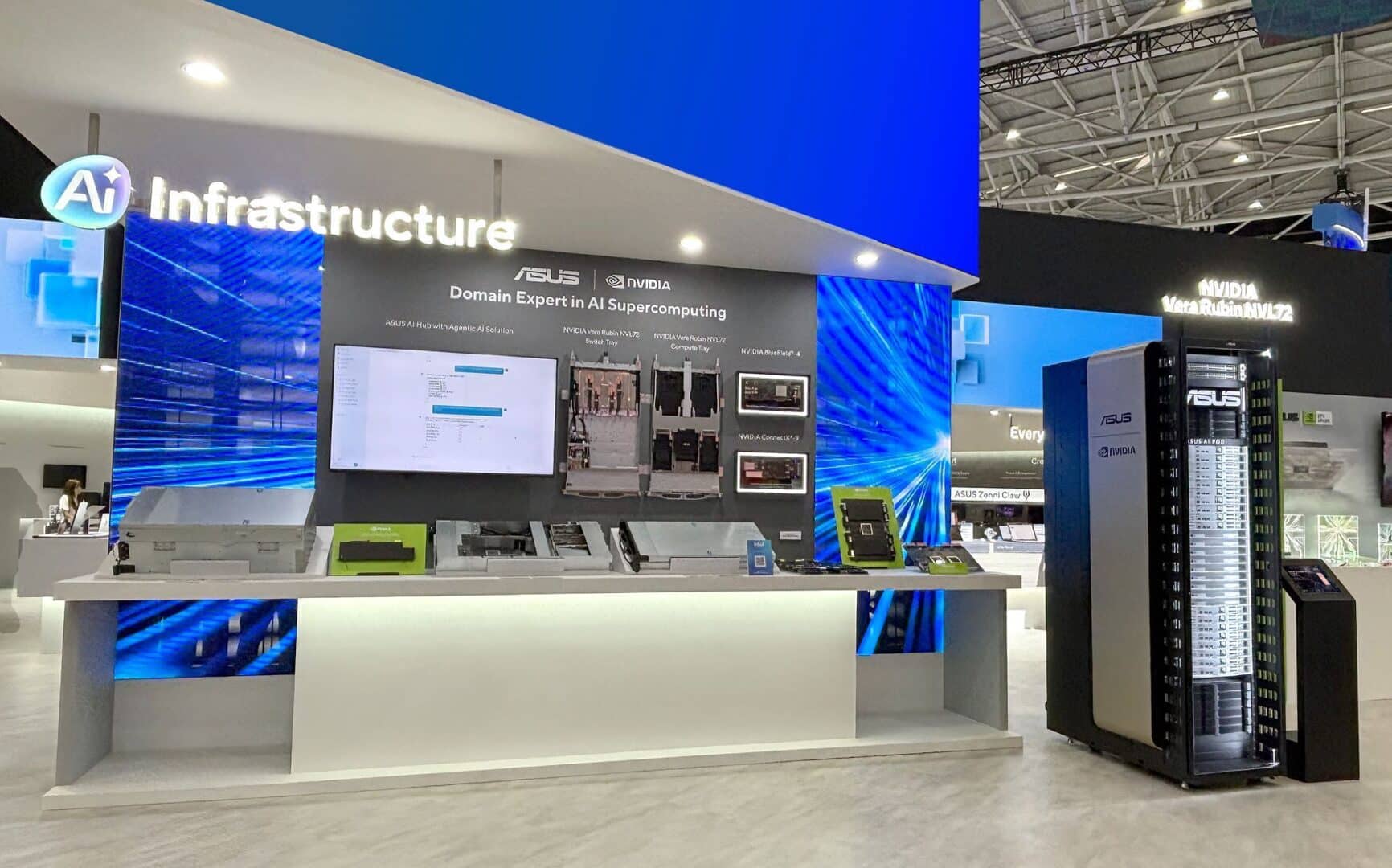
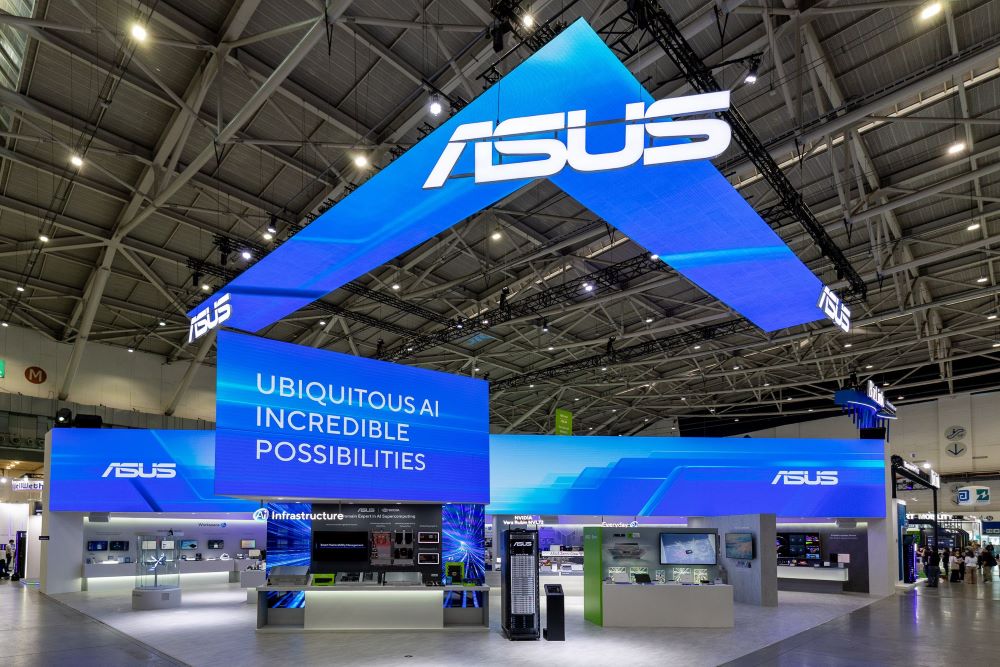
ASUS has just announced new AI data center solutions at Computex 2026. This time, they’re working directly with NVIDIA, Intel, and AMD. The goal? To help organizations get their AI projects up and running faster, and to keep costs down. The new setup covers everything from designing the infrastructure, to generating tokens at scale, to actually putting AI to work in real business settings.
Key Takeaways
- Faster Token Generation: ASUS now has rack-scale systems that cut down the wait for your first AI token. If you’ve ever been stuck waiting for a model to start, this should help.
- Advanced Simulation via NVIDIA DSX: By using OpenUSD-based digital twins, businesses can simulate power, cooling, and network layouts before physical deployment.
- Next-Generation Hardware: The new lineup includes liquid-cooled server racks built for trillion-parameter AI models.
- Optimized Storage Architecture: New storage platforms help resolve data bottlenecks for complex inference and multi-turn workflows.
Simulating AI Factories via NVIDIA DSX
Setting up a modern data center requires careful planning around power delivery, thermal management, and hardware cluster layouts. To simplify this process, ASUS is integrating its server hardware with the NVIDIA DSX platform. NVIDIA DSX serves as an infrastructure framework that provides a complete blueprint to plan, simulate, and operate data centers efficiently.
Through OpenUSD-based digital twin setups, ASUS allows operators to build a virtual replica of their server rooms. This allows engineering teams to evaluate cooling structures and network configurations before spending capital on physical assembly.
The flagship hardware system driving this initiative is the XA VR721-E3, also known as the ASUS AI POD. This system is built on the liquid-cooled NVIDIA Vera Rubin NVL72 architecture, which handles trillion-parameter AI models.
Expanded Server Lineup and Advanced Storage
Beyond the Vera Rubin platform, ASUS unveiled several server models to handle heavy enterprise workloads. The XA NR1I-E12L features a hybrid-cooled setup, while the XA NR1I-E12LR runs on a fully liquid-cooled design. Both models run on Intel Xeon 6 processors alongside the NVIDIA HGX Rubin NVL8 platform. For standard training and simulation needs, the company introduced the XA NB3I-E12 server equipped with NVIDIA HGX B300 chips.
Large artificial intelligence models often experience processing delays due to data storage bottlenecks during live inference. ASUS addresses this issue with the new CMX storage server, model UF920-E3-RS24. Powered by the NVIDIA Vera CPU, BlueField-4 DPU, and ConnectX-9 SuperNICs, this storage unit speeds up data retrieval during heavy workloads. ASUS developed this unit alongside IBM and WEKA to keep data pipelines clear and maximize server efficiency.
Practical Software Tools for Enterprise Workflows
ASUS is also introducing software packages to make this high-performance hardware usable for regular business tasks. The ASUS AI Hub, running on the ESC8000A-E13X server platform with NVIDIA NemoClaw, provides on-premises tools for organizations to set up their own autonomous assistants. This software lets companies deploy secure internal tools for coding help, human resources, and preliminary legal compliance reviews without risking data leaks.
Frequently Asked Questions
Q1. What is the primary purpose of the ASUS partnership with NVIDIA DSX?
A1. The partnership allows businesses to use the NVIDIA DSX platform to simulate and plan data center blueprints virtually before building them physically, reducing deployment risks and lowering operational costs.
Q2. Which hardware models are intended for large trillion-parameter models?
A2. The ASUS AI POD XA VR721-E3, built on the 100% liquid-cooled NVIDIA Vera Rubin NVL72 platform, is specifically designed to handle trillion-parameter workloads.
Q3. How does the new ASUS CMX storage server improve AI performance?
A3. The UF920-E3-RS24 storage server uses NVIDIA BlueField-4 DPUs and ConnectX-9 SuperNICs to provide fast access to key data caches, resolving the memory bottlenecks that slow down live inference.
Q4. Can small businesses use these systems for internal office tasks?
A4. Yes. Through the ASUS AI Hub and NVIDIA NemoClaw, organizations can create secure, on-premises AI assistants to streamline routine office tasks like human resources documentation, coding, and legal reviews.