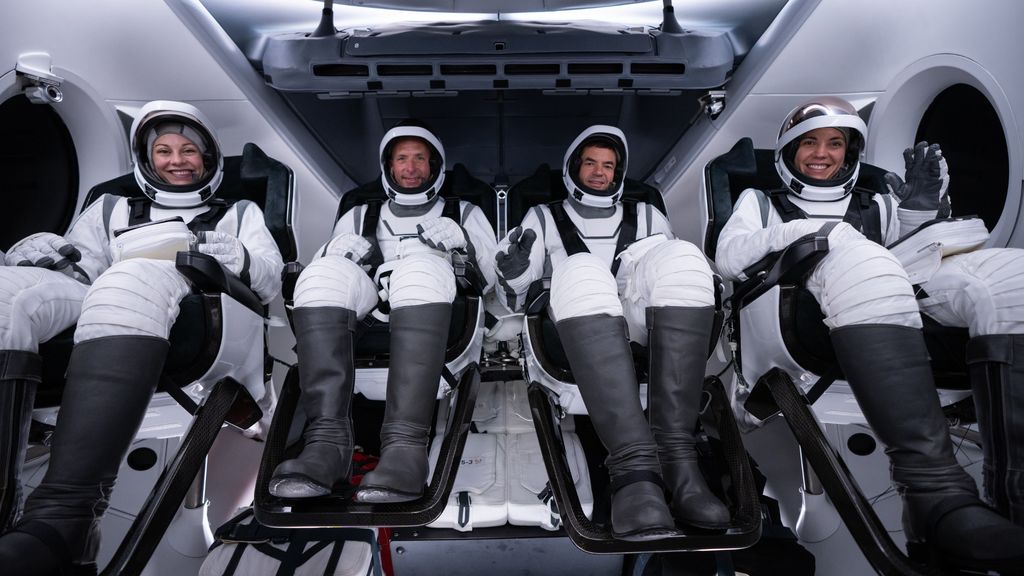
The Artemis II mission has NASA astronauts traveling to the Moon with an iPhone, which NASA Administrator Jared Isaacman announced in early 2026. Now, the four crew members can take personal photos and videos with the most familiar equipment to them. Notably, for this mission, the crew members are allowed to take personal cell phones, which has never been done on a government mission beyond the Earth’s orbit.
Key Takeaways:
- Four astronauts are using iPhones to take photos and videos during their trip around the Moon.
- NASA Administrator Jared Isaacman approved the use of commercial smartphones to simplify hardware checks.
- The phones remain in airplane mode to prevent any radio interference with the Orion spacecraft.
- This flight is the first crewed mission to the Moon in over 50 years.
- Crew members use the devices to share personal moments with their families and the public.
Artemis II is scheduled to launch on April 1, 2026, from the Kennedy Space Center, Florida. This mission marks the first time humans will exit Earth’s orbit since the conclusion of the Apollo missions 1972. The crew will consist of Commander Reid Wiseman, Pilot Victor Glover, and Mission Specialists Christina Koch, and Jeremy Hansen. They will be traveling on the Orion spacecraft which NASA designed for deep space travel and which will be launched by the Space Launch System (SLS) rocket.
The policy shift that allows crew members to carry personal smartphones is a notable change in NASA’s approach regarding agency-issued consumer electronics. Traditionally, NASA has taken a conservative approach to approving new items for use in active missions. As a consequence, astronauts have been forced to use DSLRs from 2016, for example, instead of more modern smartphones. Isaacman advocated for a more rapid approach to certification of consumer electronics for use in space. This allows a more agile approach while maintaining safe mission parameters.
All iPhones are kept in airplane mode for the entire duration of the flight. This ensures that the devices do not transmit any signals that may interfere with the navigation and communication systems of the Orion capsule. Rather, the iPhones are high-end cameras which astronauts utilize to record their activities inside the crew cabin, and to photograph the Moon and Earth through the windows.
The crew recorded videos of themselves in a zero-gravity environment and posted them on social media. An example of this is a video with an iPhone 17 Pro that appears to be passing between astronauts. In another video, Christina Koch is filming her crewmates using a phone. While we normally wouldn’t expect to see life in space as these videos portray, we do now have some videos that show a more familiar side of life in space.
The iPhones may take some decent photos, but that is not their primary purpose. All of the important mission-related communications and flight data are transmitted through the Deep Space Network, which is a series of antenna receivers on the Earth’s surface. NASA also provided professional cameras on the Orion spacecraft for research and documentation purposes.
This sort of technology is specialized, and Isaacman had encountered it before. Prior to working for NASA, Isaacman was in charge of commercial spaceflights during which crew members used wearable devices and tablets for health monitoring. Isaacman’s prior experience meant that the mission controls could be regular electronics, as long as they were properly shielded against space radiation and vibration. The mission is planned to last 10 days before the crew splashes down in the Pacific.
Frequently Asked Questions
Q1:Can the astronauts make phone calls from the Moon using their iPhones?
A1: No. The iPhones are kept in airplane mode to avoid interference with the ship. All communication with Earth happens through NASA’s official radio systems.
Q2: Which iPhone models are the astronauts using?
A2: Reports from the mission show that the crew is using the iPhone 17 Pro. These devices were picked for their high-quality cameras and video capabilities.
Q3: Why did NASA start allowing personal smartphones now?
A3: NASA Administrator Jared Isaacman pushed for the change to let astronauts document their lives more easily and to speed up the process of qualifying new hardware for space.
Q4: Are the phone batteries safe in space?
A4: Yes. NASA technicians tested the devices for radiation and battery safety before the flight to make sure they would not catch fire or fail in the oxygen-rich environment of the spacecraft.