Qualcomm Chief Executive Officer Cristiano Amon officially unveiled the Dragonwing IQ10 Robotics Reference Design at the Computex 2026 keynote in Taiwan. The blueprint offers a fully enclosed development package that resolves hardware bottlenecks by integrating compute, sensing, and networking into one deployment-ready system. Built around the premium-tier Dragonwing IQ10 processor, the system targets developers building advanced autonomous mobile robots, industrial machinery, and humanoid platforms. Qualcomm aims to streamline the transition from early prototypes to mass production by eliminating the need for fragmented third-party hardware components.
Key Takeaways
- High AI Performance: The system delivers 700 TOPS of baseline on-device AI performance, scalable up to 2,000 TOPS via external expansion modules.
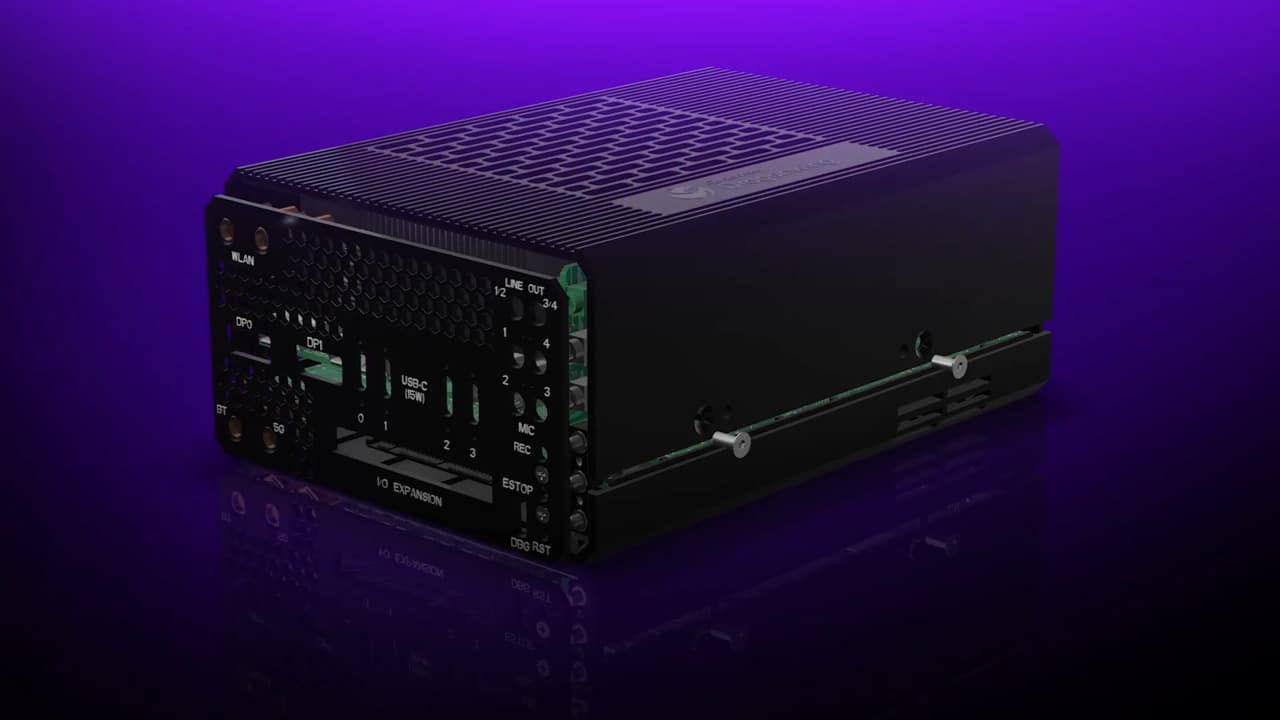
- Native Sensor Ingestion: Supports up to 12 Gigabit Multimedia Serial Link Gen 2 cameras, LiDAR, and Time-of-Flight sensors without requiring separate bridging hardware.
- Industrial Durability: The fully enclosed unit features forced-air cooling, operating reliably in extreme temperatures ranging from -40 to 70 degrees Celsius.
- Ecosystem Support: Major early access partners including NEURA Robotics, Advantech, and Thundercomm are already exploring the platform.
Native sensor integration and core specifications
Building a modern autonomous robot typically requires engineering teams to patch together separate processors, custom sensor boards, and bridging hardware. This patchwork architecture introduces data latency, drives up development costs, and complicates the system pipeline. The Dragonwing IQ10 reference design fixes this by ingesting data streams directly to the platform. It uses the industry-ready GMSL2 protocol to stream high-definition video from up to 12 cameras with minimal latency. Connections for LiDAR are routed over Ethernet, while Inertial Measurement Units have a direct host connection with the system on chip.
The processing matrix pairs 18 custom Qualcomm Oryon CPU cores with a multi-core neural processing unit and an advanced graphics architecture. This hardware arrangement allows the machine to run complex multi-modal perception, semantic mapping, and structural reasoning locally without relying on external accelerators. For memory and storage, the platform packs 64GB of high-bandwidth LPDDR5x in-package memory, 512GB of Universal Flash Storage 4.0, and a PCIe Gen5 slot for solid-state drive expansion.
Real-time control and rugged design
Production-level industrial robotics demands highly predictable behavior and tight physical synchronization. To handle precise motion execution, the hardware provides an array of high-speed deterministic interfaces, including PCIe, Time-Sensitive Networking, USB, and CAN-FD. It also includes hardware-level EtherCAT support to maintain consistent timing across multi-axis motor controllers.
Safety is managed through an independent, hardware-isolated sub-system inside the silicon. This setup ensures that critical braking vectors and obstacle avoidance routines continue to execute even if the primary operating system experiences a software exception.
The mechanical enclosure is built for harsh factory and outdoor environments. The unit accepts standard 12-volt or 24-volt power inputs and includes electrical over-voltage protection. Global commercial availability for the platform is scheduled to begin in September 2026, while initial evaluation units will seed to enterprise customers in June.
Frequently Asked Questions
Q1. What is the baseline AI processing speed of the Dragonwing IQ10 reference design?
A1. The platform provides a baseline on-device performance of 700 TOPS, which can scale up to 2,000 TOPS using external compute add-on modules.
Q2. Which operating system does the robotics platform run on?
A2. The platform uses an enterprise-grade Ubuntu Linux framework to ensure low-friction deployment and reliable software execution.
Q3. What software layers are included in the integrated robotics stack?
A3. The layered software stack includes low-latency on-device AI runtimes, native ROS2 support to decouple hardware from application logic, core platform services for navigation or manipulation, and cloud-connected fleet monitoring via the Qualcomm AI Hub.