

The much-anticipated Nothing Phone (3) has officially launched, positioned by the company as its “first true flagship” smartphone. After two generations that carved out a niche with distinctive transparent designs and the unique Glyph Interface, the Phone (3) arrives with significant internal upgrades and a revised aesthetic. While it brings welcome improvements in performance and camera capabilities, the overall design and some feature choices suggest a more measured, rather than radical, approach to the premium segment.
Key Takeaways:
- The Nothing Phone (3) is powered by the Qualcomm Snapdragon 8s Gen 4 SoC, a significant performance upgrade.
- It introduces a triple 50MP rear camera system, including a periscope telephoto lens with 3x optical zoom.
- The iconic Glyph Interface has evolved into a new “Glyph Matrix,” a micro-LED display.
- The phone features a 6.67-inch AMOLED display with a 120Hz adaptive refresh rate and 4500 nits peak brightness.
- Battery capacity increases to 5150mAh with 65W wired charging.
- The pricing positions it firmly in the premium smartphone category.
Performance and the Snapdragon 8s Gen 4
At the core of the Nothing Phone (3) is the new Qualcomm Snapdragon 8s Gen 4 System-on-Chip (SoC). This marks a substantial leap for Nothing, moving away from the upper-midrange chipsets found in previous models. The Snapdragon 8s Gen 4, fabricated on TSMC’s 4nm process, boasts an 8-core Kryo CPU with speeds reaching up to 3.21GHz and an Adreno 825 GPU. Nothing claims a 36% CPU uplift, an 88% graphics boost, and 125% faster AI processing compared to the Phone (2). This considerable increase in processing power should offer a noticeably smoother and more responsive user experience, particularly for demanding applications, high-fidelity gaming, and complex AI tasks integrated into Nothing OS.
The Snapdragon 8s Gen 4 is designed to deliver a near-flagship performance, bridging the gap between the premium 8 Gen series and the high-end 7 Gen series. While not Qualcomm’s absolute top-tier processor like the Snapdragon 8 Gen 4, the 8s Gen 4 is still part of the flagship family. This choice allows Nothing to offer high performance without necessarily incurring the highest possible component costs, a move that could be seen as strategically safe to manage pricing while elevating capabilities. The Phone (3) will be available with up to 16GB of LPDDR5X RAM and 512GB of UFS 4.0 storage, ensuring ample memory and fast data access for multitasking and storing large files.
Camera System: A Significant Upgrade
One of the most anticipated upgrades for the Phone (3) is its camera system. Nothing has moved from a dual-camera setup to a triple 50-megapixel rear camera configuration, signaling a serious push towards photographic excellence. This includes a 50MP main sensor with Optical Image Stabilization (OIS) and Electronic Image Stabilization (EIS), a 50MP periscope telephoto lens, and a 50MP ultra-wide camera.
The inclusion of a 50MP periscope telephoto camera is a first for Nothing, providing 3x optical zoom and up to 60x ultra zoom. This addition allows for greater versatility in photography, enabling users to capture distant subjects with improved detail, a feature often reserved for more established flagships. The ultra-wide sensor ensures users can capture broader scenes, while the main sensor handles everyday photography. Nothing has emphasized software advancements with its “TrueLens Engine 3,” promising improved image processing powered by AI, especially for low-light shots and cinematic effects.
For selfie enthusiasts and video callers, the Phone (3) features a 50MP front-facing camera, a notable upgrade from the 32MP sensor on the Phone (2). This higher resolution, combined with potential autofocus capabilities (as per leaks), should result in sharper and more detailed self-portraits. The phone supports 4K video recording at 60fps across all lenses with full OIS, indicating a commitment to video quality, an area where previous Nothing phones had room for improvement.
Design Evolution: Glyph Matrix and Beyond
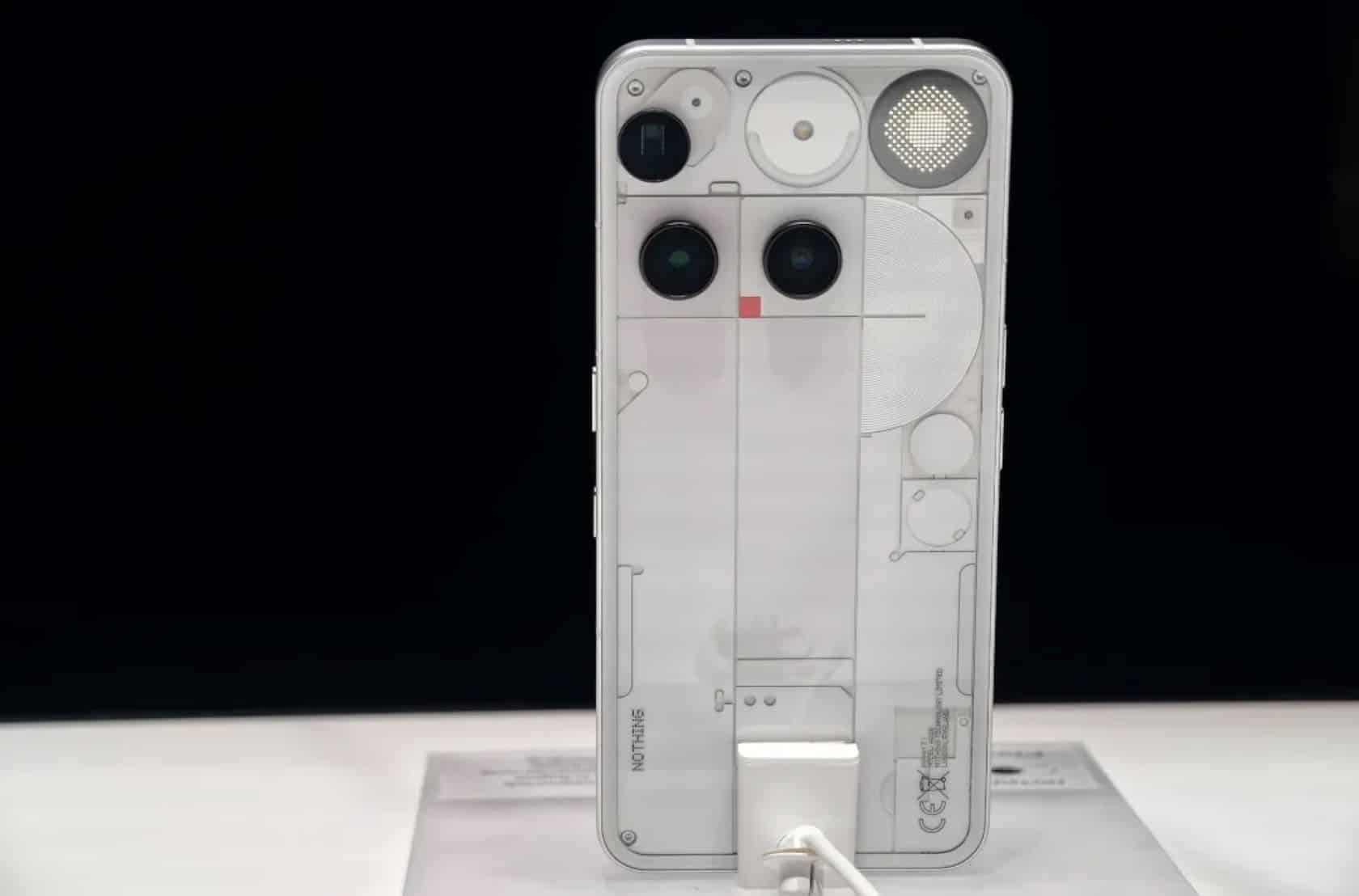
Nothing’s identity has been intrinsically linked to its transparent design and the Glyph Interface, a series of LED strips on the back of the phone that light up for notifications, charging status, and more. With the Phone (3), Nothing has iterated on this concept, introducing the “Glyph Matrix.” This micro-LED display, positioned in one corner of the rear, offers more intricate and dynamic visual cues. Instead of just static patterns, the Glyph Matrix can display app- or person-specific notifications, progress indicators, caller IDs, and even serve as a canvas for interactive “toys” like a stopwatch or simple games.
The decision to move to a smaller, more centralized Glyph Matrix rather than the expansive, symmetrical Glyph Interface of its predecessors is a significant design shift. While it maintains the transparent aesthetic with premium materials like metal and glass, the rear camera layout has also been reconfigured into a unique, somewhat unconventional tri-column arrangement. This design choice, with visible screws and sharper lines, has generated discussion, with some finding it bold and others considering it a deviation from Nothing’s signature clean lines. The phone also features a new “Essential Key,” a dedicated button that could offer customizable shortcuts or AI-driven functionalities.
Measuring 8.99mm thick and weighing 218g, the Phone (3) is slightly slimmer and lighter than some comparable flagships. It retains uniform 1.87mm bezels around its 6.67-inch flexible AMOLED display, which offers a 1.5K resolution (2800×1260 pixels), a 30-120Hz adaptive refresh rate, 1000Hz touch sampling, and an impressive peak brightness of 4500 nits (HDR) with 1600 nits (HBM). The display is protected by Corning Gorilla Glass 7i on the front and Victus on the back, and the device carries an IP68 rating for dust and water resistance, providing robust durability.
Battery, Charging, and Software
The Nothing Phone (3) is equipped with a 5150mAh silicon-carbon battery, a bump up from the 4700mAh cell in the Phone (2). This larger battery, combined with the power efficiency of the Snapdragon 8s Gen 4 and the LTPO display technology, should translate into improved battery life. Nothing claims up to 26 hours of YouTube playback and 11 hours of intensive gaming.
The Phone (3) supports 65W wired fast charging, capable of a full charge in approximately 54 minutes. It also includes 15W wireless charging and 5W reverse wireless charging, offering flexibility for topping up the device and powering other accessories.
On the software front, the Nothing Phone (3) ships with Nothing OS 3.5, based on Android 15. Nothing has confirmed five years of Android OS updates and seven years of security updates, a strong commitment to software longevity that aligns with industry leaders. Nothing OS continues to focus on a clean, bloatware-free experience with its signature monochrome aesthetic and unique dot-matrix fonts. New software features include “Essential Search” for universal smart search and “Essential Space” for AI-organized notes and content. The “Flip to Record” feature allows users to transcribe and summarize in-person conversations by placing the phone face down, leveraging the Glyph Matrix for discreet interaction.
Pricing and Market Position
The Nothing Phone (3) enters a competitive premium smartphone market. While exact global pricing may vary, reports suggest a launch price of around $799 for the base 12GB+256GB variant, with a 16GB+512GB option also available. This pricing positions the Phone (3) as a more premium offering than its predecessors, placing it in direct competition with established flagships and “flagship killer” devices from other brands. The move up the price ladder signifies Nothing’s ambition to be a serious contender in the high-end segment.
User Experience and Industry Context
Early user discussions on platforms like Reddit and X indicate a mix of anticipation and cautious optimism. While the upgraded specifications, particularly the camera and processor, are largely welcomed, the revised Glyph Matrix and camera housing design have sparked debate. Some users appreciate the iterative design while others express a desire for more groundbreaking visual innovation that initially defined the brand.
Nothing’s journey into the smartphone market began with a clear vision: to disrupt and simplify. The Phone (1) and Phone (2) captured attention with their unique design language and focused software experience. The Phone (3), by adopting more conventional flagship specifications, signals a maturation of the brand. It suggests that Nothing is now playing in a higher league, prioritizing robust performance and comprehensive features alongside its distinct identity. This shift, while arguably playing it “a little safe” in terms of radical visual departures, is a pragmatic step towards broader market appeal and sustained growth. The challenge for Nothing will be to balance this newfound maturity with the creative flair that made it stand out in the first place.
The Nothing Phone (3) represents a significant evolution for the brand. It addresses performance and camera shortcomings of previous generations with powerful hardware and a refined software experience. While the design changes are more subtle iterations than radical reinventions, the Phone (3) firmly establishes Nothing’s presence in the premium smartphone category. The strategic choice of a strong, but not bleeding-edge, processor and a comprehensive camera system reflects a calculated move to offer a competitive product without overextending. It remains to be seen how the Phone (3) will fare against entrenched competitors, but it certainly offers a compelling package for those seeking a premium Android experience with a touch of unique character.
FAQ
Q1: What is the processor in the Nothing Phone (3)?
A1: The Nothing Phone (3) is powered by the Qualcomm Snapdragon 8s Gen 4 SoC, built on a 4nm process.
Q2: What are the camera specifications of the Nothing Phone (3)?
A2: The Nothing Phone (3) features a triple 50MP rear camera setup (main, periscope telephoto with 3x optical zoom, and ultrawide) and a 50MP front camera.
Q3: Does the Nothing Phone (3) have the Glyph Interface?
A3: The Phone (3) evolves the Glyph Interface into the “Glyph Matrix,” a smaller, more dynamic micro-LED display on the rear for notifications and interactive elements.
Q4: What is the battery capacity and charging speed of the Nothing Phone (3)?
A4: It has a 5150mAh battery with support for 65W wired fast charging and 15W wireless charging.
Q5: What Android version does Nothing Phone (3) run on and how many updates will it receive?
A5: The Nothing Phone (3) runs on Nothing OS 3.5, based on Android 15. It will receive five years of Android OS updates and seven years of security updates.
Q6: Is the Nothing Phone (3) water and dust resistant?
A6: Yes, the Nothing Phone (3) has an IP68 rating for dust and water resistance.
Q7: What is the display type and refresh rate of the Nothing Phone (3)?
A7: It features a 6.67-inch flexible AMOLED display with a 120Hz adaptive refresh rate.