

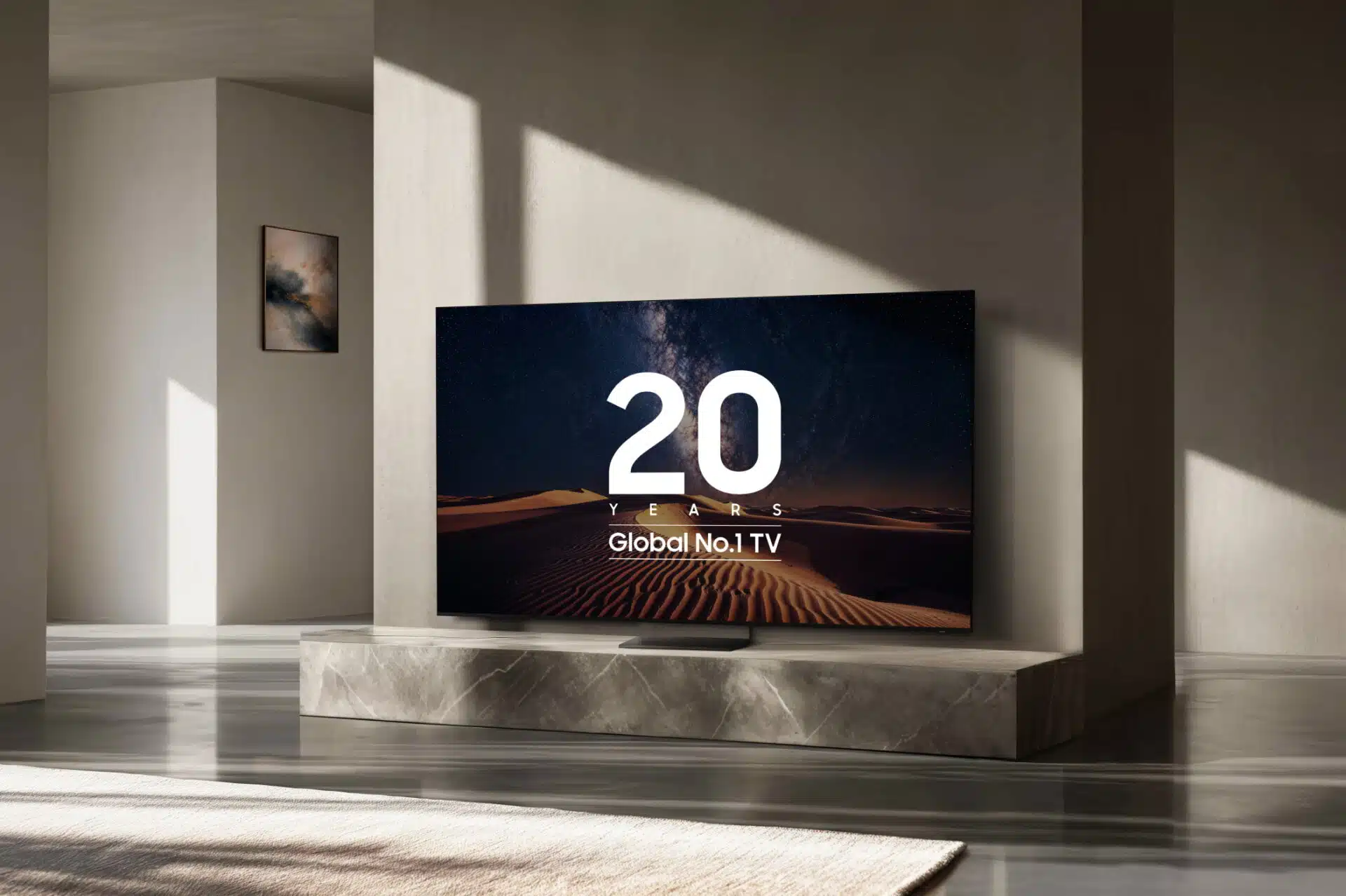
Samsung Electronics has once again secured the top position in the global television market, marking an impressive milestone. According to new data released by the market research firm Omdia, the company maintained its position as the world’s number one TV brand in 2025, holding a 29.1% share of global TV revenue.
What makes this achievement particularly notable is its consistency. Samsung has led the global TV market every year since 2006. That is two full decades at the top of an industry that rarely stays still for long. Display technologies evolve, competitors constantly push new ideas, and consumer preferences shift. Yet Samsung has managed to remain ahead through most of those changes.
In many ways, the company’s ability to adapt, and sometimes lead, major shifts in television technology has been the defining factor behind this long run.
Key Takeaways
- Samsung has been the world’s top TV brand every year from 2006 through 2025
- The company holds a 29.1% global TV market share by revenue in 2025
- Samsung dominates the premium TV segment with a 54.3% share for TVs priced above $2,500
- In the $1,500 and above category, the company maintains a 52.2% market share
- Growth is driven by Neo QLED, OLED, and lifestyle TV models such as The Frame
- Future plans include AI-powered features and expansion of Micro RGB and Mini LED technology
Two Decades of Changing How We Watch TV
Samsung’s journey toward this 20-year streak began in 2006 with the launch of the Bordeaux TV. At the time, the design stood out dramatically from conventional televisions. Instead of bulky frames and traditional speaker layouts, the Bordeaux TV introduced a sleeker silhouette with speakers positioned at the bottom and a shape inspired by a wine glass.
It may seem like a small design change today, but back then it helped redefine what a modern TV could look like in a living room.
After that breakthrough, Samsung continued to move quickly whenever the industry shifted. In 2009, the company helped push the transition from traditional LCD panels to LED-backlit TVs. Then in 2011, Samsung played a major role in popularizing Smart TVs, introducing connected features that allowed users to stream content directly without external devices.
By 2017, the company expanded the definition of what a television could be. Samsung introduced its lifestyle TV lineup, including The Frame and The Serif. These models focused not just on picture quality but also on how a television fits into the aesthetics of a home.
The Frame, for instance, displays artwork when it is not being used for watching content, effectively blending into interior decor. Meanwhile, The Serif was designed to resemble furniture rather than traditional electronics. It was a different approach, but it clearly resonated with a segment of consumers who care about design as much as technology.
Dominance in Premium and Ultra-Large TVs
The global TV market today is extremely competitive, especially with aggressive pricing from several Chinese brands. Despite this, Samsung continues to dominate the high-end segment.
According to Omdia’s data, Samsung holds a commanding 54.3% share of the premium TV market for models priced above $2,500. In the category of TVs priced above $1,500, the company still leads with a 52.2% market share.
A major reason for this dominance is the diversity of Samsung’s premium lineup.
Neo QLED televisions remain one of the brand’s flagship technologies. These TVs use Quantum Mini LEDs for more precise backlighting control, which improves contrast and brightness levels. For many viewers, especially those watching in brightly lit rooms, the high brightness of Neo QLED panels makes a noticeable difference.
Samsung has also made rapid progress in the OLED category. Historically, other manufacturers dominated OLED television shipments, but Samsung’s OLED lineup has grown quickly in recent years. Reports indicate that Samsung shipped roughly 2 million OLED TVs in 2025 alone, significantly closing the gap with long-established competitors in that segment.
Ultra-large televisions are another area where Samsung has seen strong demand. Models ranging from 75 inches to 98 inches have become increasingly popular as home entertainment setups continue to expand.
AI-Powered TVs and the Next Phase of Innovation
Looking forward, Samsung is investing heavily in artificial intelligence features across its television lineup. Modern Samsung TVs already use AI-powered processors to upscale lower-resolution video into near-4K or 8K quality, while also optimizing brightness, contrast, and sound in real time.
These systems continuously analyze the content being played and adjust picture and audio settings automatically. In theory, this means the TV can adapt whether you are watching sports, movies, or gaming content.
Samsung is also preparing to expand its Micro RGB technology in upcoming models. This display approach uses self-emissive pixels similar to OLED panels but aims to deliver even higher brightness and improved longevity.
At the same time, the company continues to push Mini LED technology into more accessible price ranges. By bringing advanced lighting systems to mid-tier models, Samsung hopes to deliver better picture quality to a broader group of consumers rather than limiting it only to flagship TVs.
Expanding Screen Sizes and Smart Features
Another important factor behind Samsung’s continued leadership is the sheer breadth of its TV lineup. The company sells televisions across a wide range of sizes, from compact 24-inch displays all the way to massive 98-inch models designed for large living rooms or home theater setups.
This range allows Samsung to compete in nearly every price category and market segment.
On the software side, Samsung’s Tizen operating system remains a core component of the TV experience. It supports a wide variety of streaming services, gaming features, and smart home integrations. For users who rely on streaming platforms or connected home devices, the operating system plays a significant role in the overall value of the TV.
Gaming features have also become increasingly important. Technologies such as FreeSync Premium Pro allow smoother gameplay and reduced screen tearing, making Samsung TVs more appealing for console and PC gamers.
Frequently Asked Questions
Q1: How long has Samsung been the number one TV brand?
A1: Samsung has held the top position in the global TV market for 20 consecutive years, from 2006 through the end of 2025.
Q2: What is Samsung’s current TV market share?
A2: According to Omdia’s 2025 data, Samsung holds a 29.1% share of the global television market based on revenue.
Q3: Which Samsung TVs are considered premium models?
A3: Samsung’s premium TV lineup includes Neo QLED 8K and 4K models, OLED TVs, and lifestyle televisions such as The Frame, The Serif, and The Sero.
Q4: What is the difference between Neo QLED and OLED?
A4: Neo QLED televisions use Mini LED backlighting to deliver high brightness and strong contrast, making them ideal for bright rooms. OLED TVs use self-emissive pixels that can turn off individually, producing perfect blacks and very high contrast, which many viewers prefer for watching movies in darker environments.
Q5: What was the Bordeaux TV?
A5: The Bordeaux TV, introduced in 2006, was the model that first propelled Samsung to the number one position in the global TV market. Its wine-glass-inspired design helped differentiate it from traditional televisions at the time.