

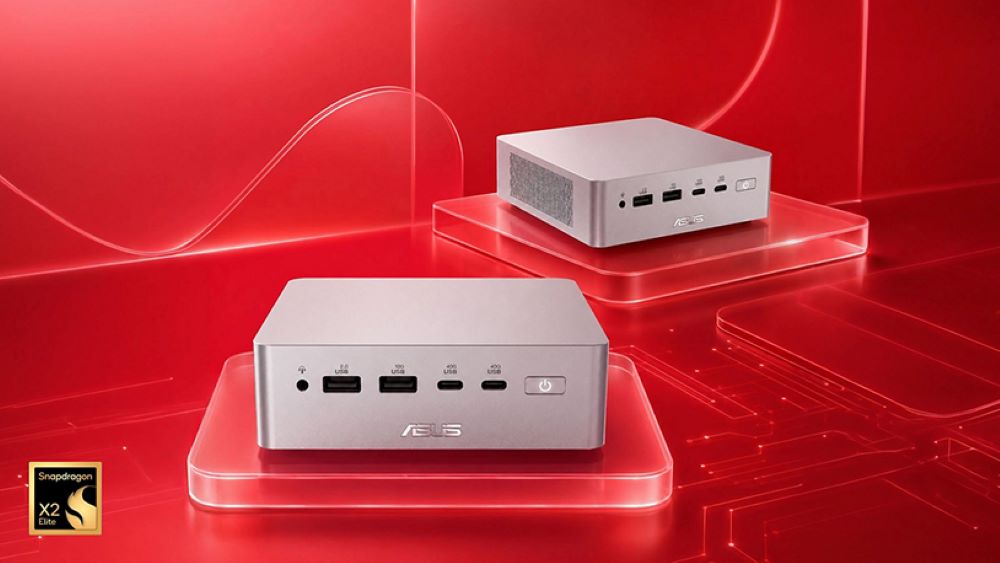
Tech brand ASUS introduced its first Artificial Intelligence mini-PC, the ASUS Ascent QN10, at the Computex 2026 event. The ultra-compact computer runs on the newly announced Qualcomm Snapdragon X2 Elite processor, shifting the chip line beyond standard Windows notebooks into small form factor desktop devices. This new hardware focuses on delivering high-end technical capabilities and on-device processing power for professional creators and coding professionals without drawing the high power typical of standard desktop setups.
Key Takeaways
- Compact Footprint: The device takes up less than 0.7 litres of total space, which makes it 86% smaller than a traditional 5-litre small form factor desktop computer.
- Processor and Memory: It utilizes an 18-core Qualcomm Oryon central processing unit and supports up to 32GB of high-speed LPDDR5X memory running at 9600 MHz.
- Artificial Intelligence Core: A built-in Hexagon neural processing unit delivers 80 trillion operations per second to run large language models and multi-step autonomous software locally.
- Abundant Port Layout: The external chassis features seven total universal serial bus ports, which include three high-speed USB4 connections and three USB 3.2 Gen 2 inputs.
- Display Support: An integrated Adreno X2 graphics processor allows users to hook up as many as four 4K visual monitors at the same time.
Small Size Meets Big Silicon Specs
The ASUS Ascent QN10 packs a third-generation Qualcomm Oryon processor that contains 18 processing cores, hitting operational speeds up to 4.7 GHz. This hardware allows the mini PC to handle substantial multi-application loads, big data operations, and localized developer testing. ASUS pairs this computing setup with advanced LPDDR5X memory options that use up to 50% less energy while giving a 20% speed bump over older memory generations.
For internal file storage, the computer supports dual solid-state drives via one M.2 PCIe Gen 5 slot and an additional M.2 PCIe Gen 4 slot. To prevent thermal throttling inside the tiny 720-gram silver enclosure, ASUS designed an internal vapor chamber cooling system alongside a dedicated cooling fan specifically tasked with keeping the fast Gen 5 solid-state storage drive at stable operating temperatures.
Local AI Handling for Developers and Businesses
The biggest talking point of the system revolves around its 80 TOPS neural processing unit. This high performance allows corporate professionals and developers to host and execute demanding machine learning systems directly on the local machine rather than sending information to cloud servers. The setup natively runs complex developer environments and local orchestrators such as OpenClaw, Hermes, Cursor, and Claude Desktop. It can manage autonomous multi-step digital actions like research analysis or electronic mail drafting right out of the box.
Enterprise security features include a physical chip-to-cloud defense layout powered by a Qualcomm Secure Processing Unit that works in tandem with Microsoft Pluton tech. On the network front, the system carries a Realtek 2.5G ethernet port and a Foxconn Wi-Fi 7 wireless card to ensure stable data transfers during heavy network tasks.
FAQs
Q1. What is the exact size and weight of the ASUS Ascent QN10?
A1. The mini PC has a volume of less than 0.7 litres, measuring 130 by 130 by 40 millimetres, and it weighs exactly 720 grams.
Q2. Can the ASUS Ascent QN10 run external multi-monitor desktop setups?
A2. Yes, the integrated Qualcomm Adreno X2 graphics unit can send display signals to up to four 4K displays simultaneously using its three USB4 ports and one HDMI 2.1 port.
Q3. What specific USB peripheral connections are present on the hardware?
A3. The device features seven total USB options: three USB4 Type-C ports, three USB 3.2 Gen 2 Type-A ports, and one standard USB 2.0 Type-A port.
Q4. Does this mini PC include expandable internal storage slots?
A4. The system accommodates dual solid-state drives, utilizing one fast M.2 2280 PCIe Gen 5 NVMe slot alongside a secondary M.2 2280 PCIe Gen 4 NVMe slot.