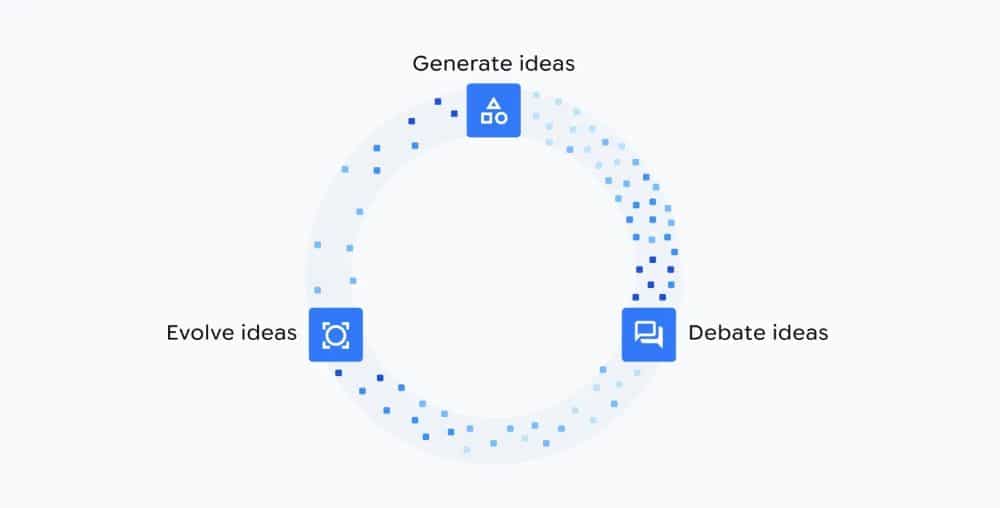
Google DeepMind just launched Co-Scientist. It’s a multi-agent AI system meant to help researchers speed up tough scientific work. The whole thing runs on Gemini, DeepMind’s large language model. Think of it as a virtual lab partner. It can generate, argue about, and tweak scientific ideas. The point is to handle the messy, non-linear way real research works. Co-Scientist does this by pulling together a group of specialized AI agents. They mimic how scientists plan experiments and review each other’s work. Early tests already show results. For example, the system helped find promising drug candidates for liver disease.
Key Takeaways
- Co-Scientist uses a team of Gemini-based agents. They handle everything from digging through research papers to coming up with new hypotheses.
- The system runs a sort of tournament of ideas. Each AI agent debates the others, then ranks and picks the best research directions.
- In lab tests at Stanford, the system’s picks blocked 91% of the cellular damage response that causes liver fibrosis.
- It connects straight to trusted web search engines and scientific databases like ChEMBL and UniProt.
How the Multi-Agent System Operates
Co-Scientist doesn’t just follow a straight line. Instead, it uses a group of specialized digital workers, all managed by a supervisor agent. The supervisor takes your research goals, written in plain language, and turns them into tasks the system can run in parallel.
First, a generation agent digs through the scientific literature. It finds focus points and suggests new starting ideas. Then a proximity agent groups these ideas together. This way, the system doesn’t just repeat itself. It actually explores different research angles.
The core validation happens The real test comes next. A reflection agent acts like a peer reviewer, checking if each idea is accurate and actually new. After that, a ranking agent compares the ideas in pairs, tournament style. This debate process borrows from the reinforcement learning used in AlphaGo. The goal is to keep only the ideas backed by solid data. At the end, an evolution agent updates and combines the best proposals. Then a meta-review agent puts together the final data for you to review.ion
Early applications show clear practical utility in medicine. Professor Gary Peltz at the Stanford University School of Medicine utilized Co-Scientist to locate existing medicines that could be repurposed to treat liver fibrosis, which causes liver scarring.
Peltz compared two drug candidates he chose manually through traditional literature review against three candidates selected by Co-Scientist. When tested on live human liver cells, the human-selected options showed no therapeutic benefit. However, two out of the three candidates found by Co-Scientist successfully blocked the progress of fibrosis and assisted in cell regeneration.
Among the successful choices was the cancer drug vorinostat. The AI found connection points across thousands of unrelated studies, identifying that vorinostat could suppress 91% of the cellular damage response responsible for liver scarring. The system is also undergoing active testing in separate collaborations to study cell aging and explore treatments for Amyotrophic Lateral Sclerosis.
FAQ
Q1. What is Co-Scientist?
A1. Co-Scientist is a multi-agent AI system developed by Google DeepMind to assist researchers by generating, debating, and refining novel scientific hypotheses.
Q2. Which AI model forms the foundation of this system?
A2. The platform is built using the Gemini model architecture, utilizing a supervisor agent to coordinate multiple specialized worker agents.
Q3. What is the tournament of ideas in Co-Scientist?
A3. It is a competitive evaluation phase where separate AI agents hold structured debates to critique, rank, and verify the accuracy of proposed hypotheses.
Q4. Has Co-Scientist achieved any real-world success?
A4. Yes. In validation tests at Stanford University, the system successfully identified a cancer drug that blocked 91% of a liver fibrosis damage response in live human cells.
Q5. Which databases can the system access to verify information?
A5. The system integrates standard web search along with specialized scientific databases including ChEMBL, UniProt, and structural prediction tools like AlphaFold.