

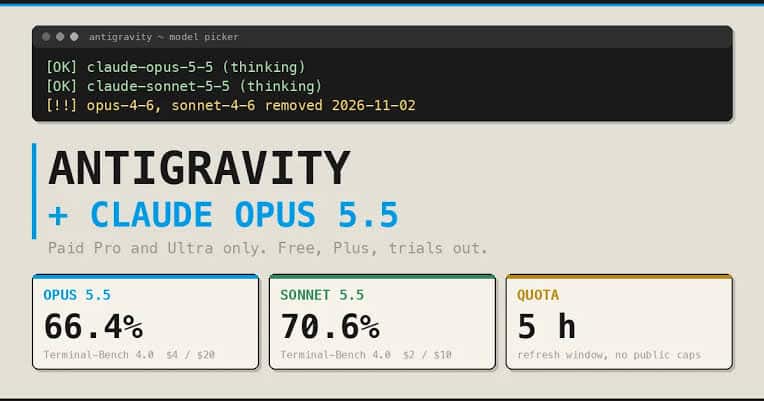
Google updated its autonomous coding workspace Antigravity on Oct. 3, 2026, adding Anthropic’s flagship artificial intelligence models, Claude Opus 5.5 and Claude Sonnet 5.5, directly into its model selector. Google Antigravity functions as an agentic developer platform that plans, writes, and tests code across complex software repositories. Anthropic, an AI safety and research company based in San Francisco, builds the Claude series of language models. The fresh additions give software engineers direct access to newer frontier models inside Google’s environment without requiring a separate Anthropic API key. However, Google has reserved both models for paying subscribers on Google AI Pro and Google AI Ultra tiers, leaving users on free or basic plans without access.
Key Takeaways
- Google Antigravity added Claude Opus 5.5 and Claude Sonnet 5.5 to its official model selector.
- Access remains limited to paying Google AI Pro and Google AI Ultra tier subscribers, excluding free accounts and trial users.
- Claude Opus 4.6, Claude Sonnet 4.6, and the open-weights model GPT-OSS-120B will leave the platform on Nov. 2, 2026.
- Claude Sonnet 5.5 offers faster code execution and lower token cost, while Opus 5.5 focuses on deep logic and agentic workflows.
Who Gets Access and Model Retirement Plans
The updated model lineup appears in the drop-down menu inside the Antigravity editor. Non-trial Google AI Pro subscribers and top-tier Google AI Ultra members can run both Claude 5.5 variants immediately. Free accounts, promotional trial tiers, and standard Google AI Plus users cannot select the two new releases.
Alongside this rollout, Google set an exit date for several older systems. Claude Opus 4.6, Claude Sonnet 4.6, and the open-source model GPT-OSS-120B will retire from Antigravity on Nov. 2, 2026. Developers running automated pipelines or saved configurations that depend on these older versions will need to point their workflows to newer models before the deadline.
Coding Benchmarks and Practical Differences
Anthropic released the 5.5 generation with targeted upgrades for software engineering tasks. Sonnet 5.5 has become the primary workhorse for daily development. On standard software agent tests like Terminal Bench 4.0, Sonnet 5.5 scored 70.6, outpacing the heavier Opus 5.5 model score of 66.4. Sonnet operates about 30 percent faster than its predecessor and uses fewer tokens to complete similar programming tasks, reducing quota consumption.
Claude Opus 5.5 remains built for long-horizon planning, multi-step debugging, and deep reasoning across entire codebases. In Antigravity, both models consume user quota allotments rather than separate metered API billing. Because complex agentic queries with Opus 5.5 draw substantial compute, users should manage their limits when running long debugging cycles.
Frequently Asked Questions
Q1. Can free users access Claude Opus 5.5 in Google Antigravity?
A1. No. Google requires a paid, non-trial Google AI Pro or Google AI Ultra subscription to use Claude Opus 5.5 and Sonnet 5.5.
Q2. When will Google remove older Claude models from Antigravity?
A2. Google will retire Claude Opus 4.6, Claude Sonnet 4.6, and GPT-OSS-120B on Nov. 2, 2026.
Q3. Do I need an Anthropic API key to use these models in Antigravity?
A3. No separate Anthropic API key is needed. The models operate directly through your active Google AI plan quota.
Q4. Which model is better for everyday coding tasks?
A4. Claude Sonnet 5.5 is faster, cheaper on quota, and scored higher on terminal benchmarks, making it suitable for routine code generation and refactoring.