


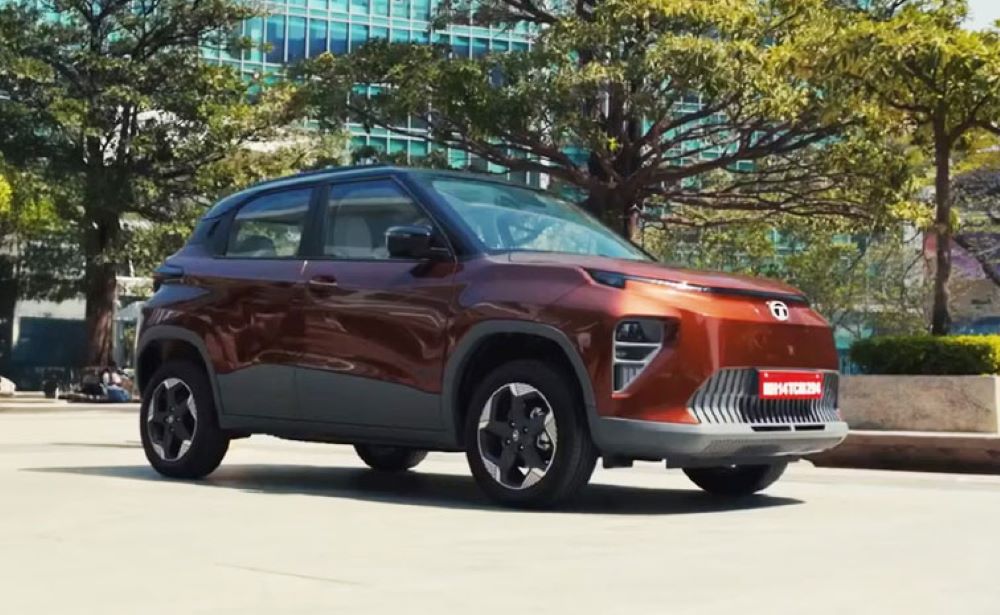
Tata Motors has revised the prices of the Punch EV across its entire lineup, raising ex-showroom figures by Rs 10,000 to Rs 20,000. Following this price revision, the entry-level electric SUV now starts at Rs 9.79 lakh and goes up to Rs 12.99 lakh (ex-showroom) for the top trim. The automaker structured the hike based on battery capacity, keeping changes strictly financial without altering technical specifications or mechanical equipment.
Key Takeaways
- Base model price now begins at Rs 9.79 lakh, while the range-topping Empowered+ S reaches Rs 12.99 lakh.
- Trims with the smaller 30 kWh battery pack receive a uniform price hike of Rs 10,000.
- Trims equipped with the larger 40 kWh battery pack are now costlier by Rs 20,000.
- Under the Battery-as-a-Service (BaaS) program, vehicle acquisition remains available at an initial Rs 6.49 lakh, plus Rs 2.60 per kilometer for battery usage.
- Mechanical equipment, electric motor outputs, and battery configurations remain unchanged.
Price Adjustment Based on Battery Size
Tata Motors has tied the quantum of the price rise directly to the battery configuration. The entry-level Smart and mid-tier Smart+ variants equipped with the 30 kWh pack are costlier by Rs 10,000, bringing their prices to Rs 9.79 lakh and Rs 10.39 lakh, respectively.
The longer-range 40 kWh trims received the higher Rs 20,000 hike. The Smart+ 40 kWh now sells for Rs 11.19 lakh, the Adventure 40 kWh stands at Rs 11.94 lakh, and the Empowered 40 kWh costs Rs 12.69 lakh. The top-tier Empowered+ S 40 kWh retails at Rs 12.99 lakh. The Smart+ trim remains the only variant offering buyers a choice between both battery capacities, with an Rs 80,000 difference separating the two.
Powertrain Specifications and Real-World Range
The hardware underneath the vehicle remains identical to earlier iterations. The 30 kWh models rely on a 65 kW permanent magnet synchronous motor that puts out 88 PS of power and 154 Nm of torque. In contrast, the 40 kWh editions receive a 95 kW motor that produces 130 PS and 154 Nm of torque, clocking zero to 100 km/h in nine seconds.
Official testing cycles rate the 30 kWh battery for 365 to 375 kilometers, while the 40 kWh version provides an ARAI-certified figure of 468 kilometers. Under Tata Motors‘ C75 standard, realistic driving conditions yield between 260 and 275 kilometers for the smaller pack, while the larger unit typically delivers 335 to 355 kilometers. Charging options include 3.3 kW home setups, 7.2 kW AC wall boxes, and DC fast-charging up to 65 kW, which charges the battery from 20 percent to 80 percent in 26 minutes.
Frequently Asked Questions
Q1. What is the updated starting price of the Tata Punch EV?
A1. The Punch EV now starts at an ex-showroom price of Rs 9.79 lakh for the base Smart 30 kWh variant.
Q2. How much has the price increased across different trims?
A2. The 30 kWh variants are costlier by Rs 10,000, while the 40 kWh variants received a price hike of Rs 20,000.
Q3. Are there any design or feature additions with this price increase?
A3. No, the update is purely financial to offset production costs, with no alterations to styling, features, or battery specs.
Q4. What is the price of the Punch EV under the Battery-as-a-Service model?
A4. Under the BaaS model, the vehicle carries an upfront price starting at Rs 6.49 lakh, with a recurring battery usage rate of Rs 2.60 per kilometer.