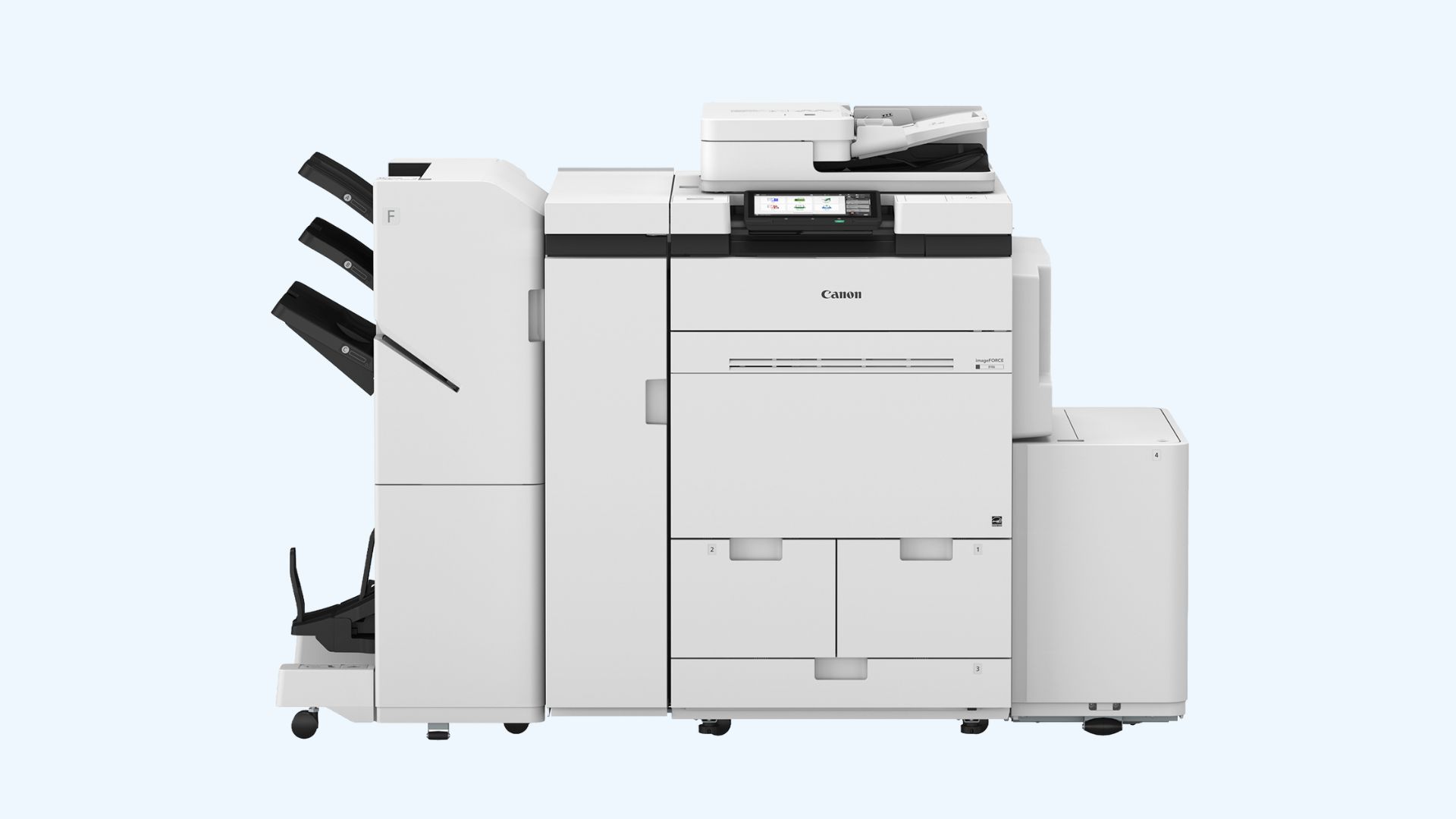
Canon India has expanded its professional printing portfolio with the launch of the imageFORCE 8100 series, a move that feels both timely and very much in tune with the realities of the Indian print market. Built specifically for copy shops, book publishers, and commercial print service providers, the new lineup includes three models: imageFORCE 8105, imageFORCE 8195, and imageFORCE 8186. These machines deliver monochrome print speeds of 105, 95, and 86 pages per minute respectively.
At a broader level, this launch signals Canon’s intent to capture a larger share of India’s monochrome production printing segment. Despite the steady growth of digital media, demand for black-and-white printing remains strong, particularly for academic textbooks, legal documentation, manuals, and institutional materials. In many ways, this series appears designed around that ongoing reality rather than chasing short-lived trends.
Key takeaways:
- High-Speed Output: The series supports speeds of up to 105 pages per minute, making it suitable for high-volume, deadline-driven environments.
- Superior Resolution: Powered by R-VCSEL laser technology, the printers deliver a sharp output resolution of 2,400 x 2,400 dpi.
- AI Maintenance: AI-assisted smart maintenance predicts component lifespan, helping reduce unexpected downtime.
- Versatile Media Handling: Supports media weights ranging from 52 to 300 gsm, including coated paper stocks.
- Banner Printing Capability: Handles long-format media up to 1,300 mm for specialized and value-added print applications.
Precision imaging with R-VCSEL technology
The imageFORCE 8100 series brings advanced imaging capabilities into the monochrome production space. By using Canon’s 32-beam R-VCSEL (Red Vertical-Cavity Surface-Emitting Laser) technology, these machines achieve a resolution of 2,400 x 2,400 dpi. This level of detail is especially important for technical documents, academic texts, and legal papers where small fonts, fine lines, and barcodes must remain perfectly legible.
What stands out here is how the laser system minimizes what is often referred to as “scatter,” a common issue that can make black-and-white graphics appear soft or slightly blurred. As a result, halftones and gradients in journals, manuals, and instructional materials appear noticeably cleaner. Canon has also improved barcode reproduction, upgrading performance from standard industry levels to the highest “A-C” ratings. For logistics-heavy environments and government documentation, this is not a minor upgrade, it is often a non-negotiable requirement.
Enhanced media handling and flexibility
Paper versatility has long been a pain point for Indian print service providers, particularly when switching between different stocks during busy production cycles. The imageFORCE 8100 series addresses this by supporting coated media in the 91 to 150 gsm range. This makes it possible to produce higher-quality book covers, inserts, and premium newsletters that were previously difficult to run on conventional monochrome machines.
The ability to print on banner-sized media up to 1,300 mm, or 51 inches, also opens up additional opportunities. Print shops can now offer fold-out diagrams, posters, training charts, and long-format brochures without outsourcing the work. Combined with an upgraded feeder system that supports up to 9,360 sheets, the machines are clearly designed for long, uninterrupted print runs, something that becomes especially important during peak academic and examination seasons.
Smart maintenance and operational efficiency
Unexpected breakdowns can be costly, particularly for print businesses operating on tight deadlines and thin margins. To address this, Canon has integrated AI-assisted smart maintenance into the imageFORCE 8100 series. The system continuously monitors internal components and uses machine learning to predict potential failures before they occur. This allows service teams to intervene early, often before any noticeable disruption happens.
From a business perspective, this kind of predictive maintenance can make a real difference. It allows repairs to be scheduled during off-hours, rather than halting production in the middle of a critical job. Over time, this could translate into better client trust and fewer missed delivery commitments.
Canon has also paid attention to sustainability and usability. The machines are constructed using approximately 30 percent recycled plastic, and the user interface has been redesigned for clarity and ease of use. A 10.1-inch color touch panel simplifies complex tasks such as booklet creation and document insertion, reducing operator fatigue during long shifts.
Frequently Asked Questions
Q1: Who is the primary audience for the imageFORCE 8100 series?
A1: The series is designed for copy shops, commercial print service providers, jobbers, and book publishers that require high-volume, professional-grade monochrome output.
Q2: What is the maximum paper weight supported?
A2: The printers support media weights from 52 gsm up to 300 gsm, including duplex printing on heavier stocks.
Q3: How does the AI-assisted feature benefit print businesses?
A3: The AI system predicts when components such as rollers or laser units may need replacement. This allows maintenance to be planned in advance, helping avoid unexpected downtime during busy working hours.
Q4: Do these printers support color printing?
A4: No, the imageFORCE 8100 series is a dedicated black-and-white production line. For color production requirements, Canon offers the imageFORCE C5100 and C6100 series.
Q5: What is the maximum print speed available?
A5: The flagship model, imageFORCE 8105, delivers a top speed of 105 A4 pages per minute, making it suitable for demanding production environments.