

Researchers at the Massachusetts Institute of Technology have built a reconfigurable robotic optics laboratory that can pick up optical parts, position them on a table, and build a functioning laser cavity in less than 30 minutes. The automated setup handles optical alignment tasks that usually require days or weeks of manual human labor, completing the assembly in 50 separate movements.
Key Takeaways
- The robotic platform assembled a functional tabletop laser cavity in under 30 minutes using 50 autonomous steps.
- The system uses a seven-joint robotic arm, two overhead cameras, and a custom motorized tuner to position mirrors with micron-level accuracy.
- When researchers physically disturbed parts during testing, the robot automatically realigned the optical path to restore beam intensity.
- MIT plans to connect the hardware to cloud software so scientists around the world can submit optics tests remotely.
How the Automated Optics Lab Works
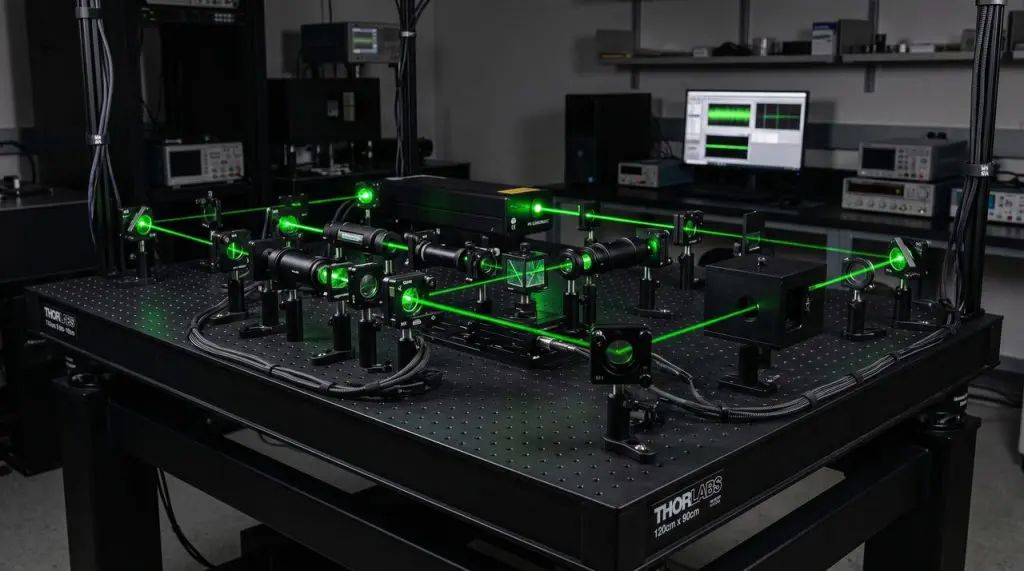
Optics experiments require precise placement of mirrors, lenses, and beam splitters. In traditional university labs, researchers turn tiny adjustment screws by hand to guide light paths, relying on touch and trial. A small bump to a table can ruin hours of work.
The MIT system tackles this problem with physical robotics and computer vision. At the center of the workstation sits a robotic arm with seven joints mounted over a metal optical table. Two overhead cameras track the table surface, identifying optical hardware by reading quick-response codes printed on custom component mounts.
Once the robot places a component, a specialized wireless tool handles fine adjustments. The battery-powered gadget clips onto standard optical holders and turns the adjustment knobs to micron-level accuracy. Sachin Vaidya, a postdoctoral researcher at the MIT Research Laboratory of Electronics, explained that the platform starts with scattered parts and finishes with a functioning, aligned laser without human intervention.
Self-Correction and Remote Testing
The hardware also solves the problem of laboratory drift. Environmental heat and minor floor vibrations routinely push delicate optics out of balance. During trial runs, researchers deliberately nudged parts out of place. Sensors detected the drop in laser output, prompting the arm and tuner to realign the path until full beam strength returned.
Marin Soljacic, a physics professor at MIT, stated that machines do not get tired during repetitive alignments. The team is now creating a cloud interface so outside teams can upload protocols and run optical trials continuously, aiding research into solar panels, displays, augmented-reality headsets, and quantum hardware.
Frequently Asked Questions
Q1. What did the MIT robotic optics lab accomplish?
A1. The robotic system autonomously identified scattered optical components, placed them on a metal table, and aligned a functioning laser cavity in 50 actions within 30 minutes.
Q2. How does the robot make fine adjustments to mirrors?
A2. The system uses a specialized wireless motorized tool that attaches to component mounts and rotates fine adjustment knobs with micron-level precision.
Q3. Can the robot fix misalignments caused by vibrations?
A3. Yes. When components are disturbed, sensors detect beam loss and the software coordinates automated adjustments to restore correct alignment.
Q4. What practical applications will this automated lab support?
A4. The platform can test optical materials for solar cells, augmented-reality lenses, display screens, and quantum technology devices.