

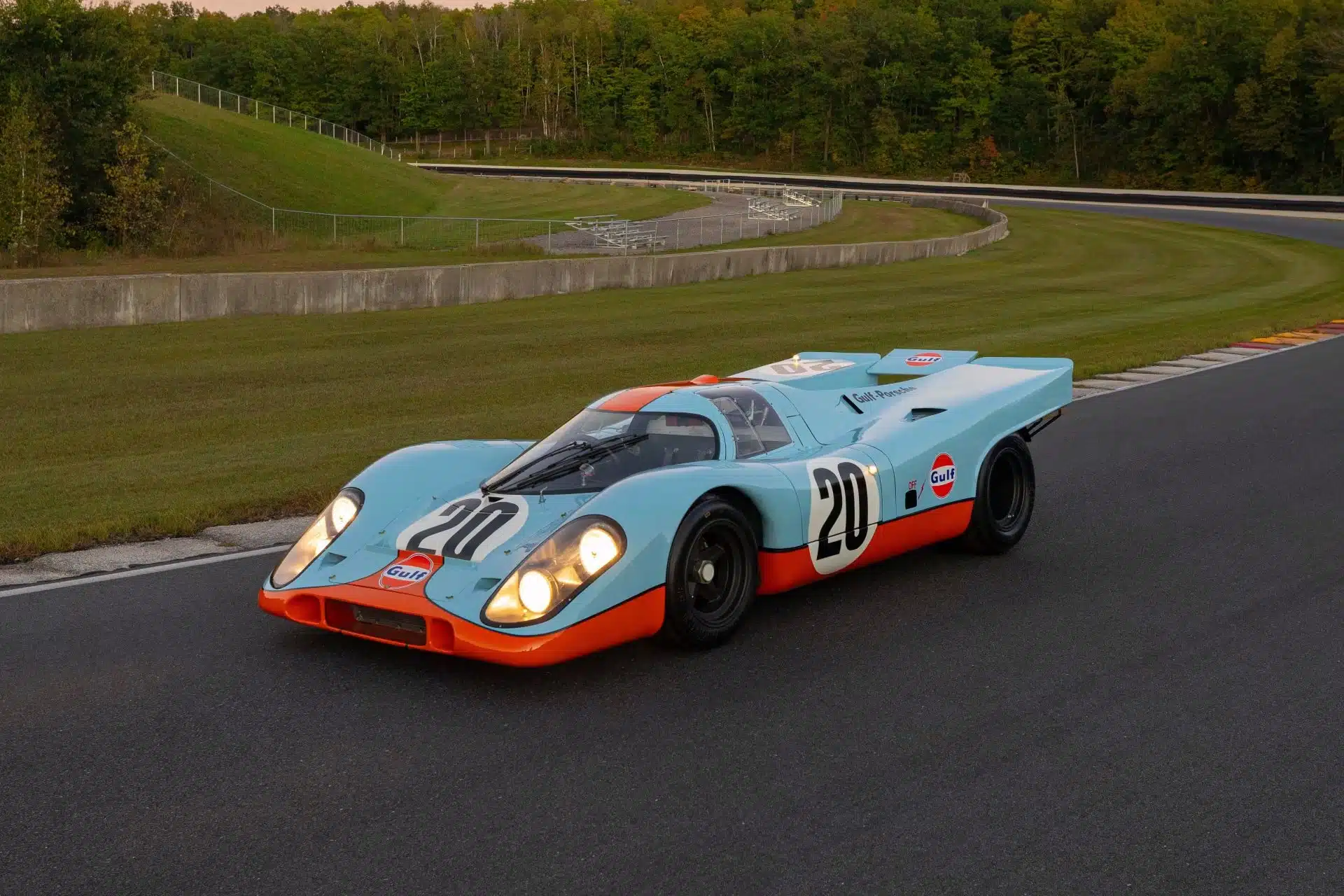
Fifty years ago, something truly extraordinary happened. A machine built for the absolute edge of performance, a car synonymous with the roar of the Mulsanne Straight and the grueling 24 Hours of Le Mans, ventured out of its natural habitat and onto public roads. This wasn’t a parade lap or a controlled demonstration; it was a genuine journey, a bold statement that defied convention and captured the imagination of car enthusiasts worldwide. On April 28, 1975, a Porsche 917, chassis 030 to be precise, embarked on an audacious adventure, driving from Weissach, Germany, to Paris, France.
The Porsche 917 was, and remains, an icon of endurance racing. Developed to conquer Le Mans, it was a no-compromise race car, brutally fast and notoriously challenging to handle in its early iterations. It brought Porsche their first overall victory at the Sarthe circuit in 1970 and dominated the 1970 and 1971 seasons of the World Sportscar Championship. These were machines built purely for competition, stripped of any creature comforts, and engineered for maximum speed and downforce on dedicated race tracks. The idea of one appearing on a public road network seemed preposterous.
Yet, this is precisely what happened. The man behind this improbable feat was Italian businessman and Martini heir, Count Gregorio Rossi di Montelera. A fervent Porsche enthusiast with a passion that clearly knew no bounds, Count Rossi acquired 917 chassis 030. This car had its own racing history, competing in the 1971 season before being used for testing. But Count Rossi had a different vision for it – he wanted to drive it on the road.
Making a full-blown Le Mans prototype street-legal was no small undertaking. The 917 in its original form was loud, hot, and lacked essentials like proper exhaust silencers, turn signals, or even a horn. A dedicated team within Porsche, demonstrating the brand’s willingness to cater to its most passionate customers, took on the challenge. They fitted rudimentary mufflers to tame the thunderous flat-12 engine note, added mirrors for visibility, installed side indicators, and yes, even a horn. A spare tire, a requirement for endurance racing back then, found a spot beneath the rear clamshell.
Inside, while still very much a race car, there were touches to make the journey slightly less punishing. The two seats, a standard for endurance racers, were reupholstered in tan leather, reportedly commissioned from Hermes. Suede lined the roof, doors, and dashboard, a small concession to comfort in a spartan cockpit. The wooden gear shifter knob remained, as did the lightweight, drilled ignition key – reminders of the car’s racing pedigree.
With these modifications in place, and sporting an Alabama license plate somehow obtained by Count Rossi (European authorities in Germany, France, and Italy had reportedly declined registration), the stage was set. On April 28, 1975, 917 chassis 030 left Weissach. Its destination wasn’t a nearby circuit, but the bustling streets of Paris, hundreds of miles away.
Imagine the scene: a legendary race car, one that spectators had only ever witnessed at blistering speeds on closed tracks, suddenly appearing on regular roads, navigating traffic, and turning every single head it passed. It was a spectacle, a moment of pure, unadulterated automotive daring. The drive itself became part of the legend, a testament to the power of one individual’s dream and Porsche’s commitment to realizing it, no matter how ambitious.
This bold journey of 917 chassis 030 wasn’t just a random act of eccentricity; it embodied a spirit of adventure and pushing boundaries that has always been part of the Porsche ethos. It showcased that the raw performance and engineering excellence developed for the track could, with enough passion and ingenuity, be brought into the everyday world.
Fifty years on, 917 chassis 030 still exists and is enjoyed by its current owner on public roads in the South of France, now registered in the U.K. It underwent restoration work, preserving its original paint and interior, preparing it for future drives and appearances. The fact that a car built purely for the crucible of endurance racing could be adapted and driven legally on the street is a powerful narrative. It speaks to the fundamental engineering integrity of Porsche’s race cars and the enduring desire of enthusiasts to get closer to these legendary machines.
Porsche today celebrates this anniversary, acknowledging the “audacious adventure” that took place half a century ago. It serves as a reminder of the brand’s rich history, its close ties to motorsport, and the passionate individuals who have been part of its story. While modern regulations and the complexity of contemporary race cars make such a conversion highly improbable today, the spirit of that 1975 journey lives on. It sparks the imagination and prompts us to consider the extraordinary possibilities when passion meets engineering skill. The sight of a Porsche 917 on public roads back then was a moment of delightful disbelief, a fleeting overlap of the racing world and the everyday world that created an enduring legend. Fifty years later, that legend continues to inspire.