

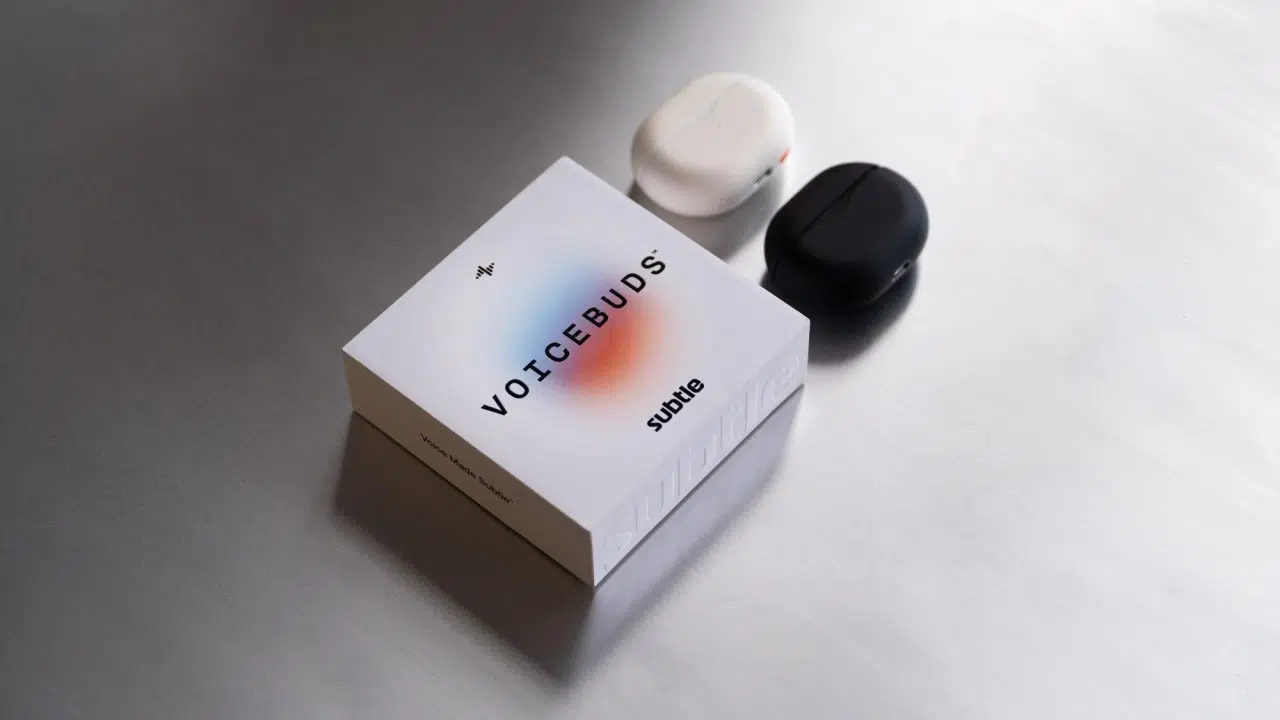
Voice AI startup Subtle has officially stepped into the hardware space with the launch of its first pair of wireless earbuds. The company is clearly aiming to tackle a familiar frustration: using voice commands in public without feeling awkward or misunderstood. Announced just ahead of the Consumer Electronics Show (CES) 2026 in Las Vegas, these earbuds are built around one central idea. Prioritizing how clearly your voice is captured, rather than how much outside sound you can block out.
Instead of focusing on traditional noise cancellation, Subtle’s earbuds emphasize outgoing voice clarity. The company says its proprietary AI models can accurately transcribe speech even when the user is whispering. In practical terms, this means you could dictate notes, reply to messages, or take calls in a loud cafe or a quiet shared office without drawing attention to yourself. It sounds ambitious, but during early demos, the concept appeared to hold up surprisingly well.
Key Takeaways
- Specialized Voice Focus: Unlike standard earbuds designed mainly to reduce incoming noise, Subtle’s approach centers on isolating the user’s voice for clearer calls and dictation.
- Transcription Accuracy: Subtle claims its earbuds produce five times fewer transcription errors than AirPods Pro 3 when paired with OpenAI’s transcription models.
- Custom Hardware: A dedicated onboard chip allows the earbuds to wake a locked iPhone, enabling hands-free voice notes without touching the device.
- Pricing and Availability: The earbuds are priced at $199 (approximately ₹16,500) and include a one-year subscription to the Subtle app for iOS and Mac.
- Whisper Support: The system can capture and transcribe extremely low-volume speech, allowing for private interactions even in shared or quiet environments.
Cutting Through the Noise with AI
Subtle is positioning itself as more than just another voice app company. With this launch, it is pushing toward what it calls a “voice-first” interface. Most mainstream earbuds from brands like Apple or Sony rely on Active Noise Cancellation to improve listening quality. Subtle essentially flips that idea. Its AI models are trained to recognize the user’s unique acoustic fingerprint and separate it from surrounding noise like traffic, conversations, or office hum.
During a demonstration, CEO Tyler Chen showed the earbuds capturing a usable voice note while he whispered in a noisy room. For professionals who rely on dictation, this could be meaningful. Voice input often works fine in theory but falls apart in real-world environments. By running its machine learning models directly on a specialized chip inside the earbuds, Subtle reduces the latency that usually comes with cloud-based voice processing. That small detail may end up making a noticeable difference in daily use.
Bridging the Gap Between Hardware and Software
The company is clearly aware of existing competitors like Wispr Flow and Superwhisper. Those tools work well, but they depend heavily on standard phone microphones. Subtle’s approach is different. The hardware itself is optimized for voice capture, using a multi-microphone array and custom firmware designed specifically for dictation and transcription.
One interesting feature is the ability to interact with a locked iPhone. This means you can quickly record a thought, send a message, or create a voice note without pulling your phone out of your pocket. For some users, that convenience alone might justify the switch. It feels like one of those features you do not realize you want until it is there.
The $199 price includes a one-year subscription to the Subtle AI app. After that, reports suggest a monthly fee of around $17 may apply for continued access to premium features such as instant dictation across any application. The earbuds are available for pre-order in Parchment White and Ink Black, with U.S. shipping expected to begin in the early months of 2026.
Why Voice Is Becoming the New Interface
Tyler Chen has been fairly open about his belief that typing is often slower and less natural than speaking. Many people would probably agree with that, at least in principle. Still, social discomfort has held voice technology back. Nobody wants to be the person loudly talking to their phone in public.
Subtle’s solution is to make whisper-level speech readable to machines while remaining nearly inaudible to people nearby. If it works consistently, this could make voice input feel more socially acceptable, especially for work on the move. The company has already raised $6 million in funding and is collaborating with partners like Qualcomm and Nothing to broaden its ecosystem. Whether this approach becomes mainstream is still an open question, but it is a thoughtful attempt at solving a real problem.
Frequently Asked Questions
Q1: How are Subtle earbuds different from AirPods?
A1: AirPods are designed primarily for music playback and general calls. Subtle earbuds are built specifically for high-accuracy transcription and dictation. They use custom AI models to separate your voice from background noise, with the company claiming significantly higher accuracy for voice notes and AI-driven conversations.
Q2: Can I use these earbuds with an Android phone?
A2: At launch, the Subtle app is only available for iOS and macOS. The earbuds may function as standard Bluetooth headphones on Android, but advanced features like waking a locked phone and deep app integration are currently limited to Apple devices.
Q3: What happens after the one-year app subscription ends?
A3: The earbuds will continue to work for music and calls. However, access to advanced AI dictation and instant voice note features will likely require renewing the Subtle AI membership for a monthly fee.
Q4: Is my data private if the AI is always listening?
A4: Subtle states that much of its voice isolation and transcription processing happens on-device. This means your speech is handled by the earbuds and your phone rather than being sent to cloud servers for constant processing, which should help reduce privacy concerns.