

Panasonic Group has clearly crossed a threshold with its artificial intelligence strategy. What once felt like long-term planning or conceptual roadmaps is now very much in motion. At CES 2026 in Las Vegas, held from January 6 to 9, the company presented a wide range of AI-driven solutions under the theme “The Future We Make.” Walking through the exhibition, it was evident that Panasonic is less focused on abstract AI potential and more on how these technologies actually function in demanding, real-world environments.
The showcase centered on practical responses to global challenges, particularly those tied to data center infrastructure, business operations, and environmental sustainability. Rather than highlighting isolated innovations, Panasonic framed its technologies as interconnected systems designed to scale, adapt, and solve problems that are already pressing industries today.
Key Takeaways
- AI Infrastructure: New cooling pumps and compressors for data centers deliver up to 75 percent higher flow rates, addressing the heat generated by high-density AI servers.
- Smart Supply Chains: Collaboration with Blue Yonder enables warehouse automation through robotics and Edge Interactive Tables that provide real-time inventory visibility.
- Green Transformation: The Panasonic GREEN IMPACT initiative introduced glass-integrated solar cells and robotic systems designed to automate appliance recycling.
- B2B Enhancements: CPS 2.0 combines IoT, sensors, and AI to visualize and resolve complex on-site challenges across retail and logistics operations.
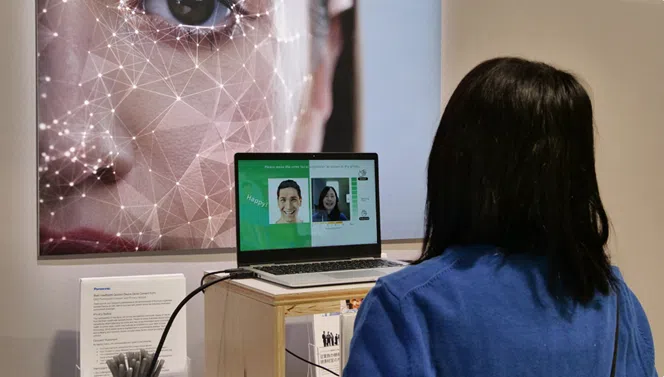
- Wellness Tech: Proprietary AI technology now estimates brain age through facial analysis, offering a new approach to preventive healthcare.
Cooling and Powering the AI Infrastructure
As generative AI workloads continue to expand, data centers are facing increasingly serious challenges around heat and power stability. Panasonic addressed this head-on by introducing high-performance liquid cooling pumps developed for Coolant Distribution Units, or CDUs. These pumps are compact, but they move substantially more coolant than previous designs, which is critical for today’s densely packed Graphic Processing Units used in AI training.
Power management was another major focus. Panasonic Energy showcased rack-integrated energy storage systems equipped with a peak shaving function. These systems store electricity during periods of low demand and release it when demand spikes, easing pressure on the power grid and helping operators control energy costs. On a more granular level, Panasonic relies on SP-Cap capacitors and MEGTRON circuit board materials. Together, these components reduce electrical noise and signal loss, allowing servers to sustain high-speed data transmission without the instability or overheating that can lead to failures.
Transforming Workplaces with B2B Solutions
In logistics and retail, Panasonic is leaning heavily into the idea that AI works best when paired with on-site expertise. Through its subsidiary Blue Yonder, the company demonstrated the Edge Interactive Table, a system that gives warehouse managers a real-time digital view of their facilities. From this interface, AI can optimize robot movement, track inventory through RFID sensors, and adjust workflows as conditions change. It feels less like a dashboard and more like a living model of the warehouse itself.
Retail environments received similar attention. Hussmann, a Panasonic company, introduced freezer cases that use R-290, a natural refrigerant known for its lower environmental impact. These units connect to StoreConnect, an AI-powered monitoring system that tracks temperature and equipment health remotely. The practical benefit here is fairly straightforward. Fewer manual inspections, less food spoilage, and quicker responses to maintenance issues.
Environmental Solutions and Green Transformation
Green Transformation, or GX, stood out as one of the more cohesive themes across Panasonic’s CES presence. One of the most talked-about innovations was glass-integrated perovskite solar cells. Using inkjet printing and laser processing, these lightweight cells can be embedded directly into windows and walls. Buildings, in effect, become power generators without the need for bulky rooftop panels. It is a subtle shift, but potentially a significant one for urban energy use.
Panasonic also addressed what happens at the end of a product’s life. The Disassembly CPS, or Cyber-Physical System, uses AI to understand how appliances were originally assembled. Robots are then guided through optimized disassembly processes, informed by 3D simulations that account for damaged or rusted components.
By refining these movements, the system can recover high-purity resins and metals from products like washing machines and microwaves. The approach supports a circular economy model, and while full automation is still a work in progress, the direction is clear and intentional.
Frequently Asked Questions
Q1: What is the Brain Healthcare Quotient, or BHQ, shown at CES?
A1: The BHQ is a metric used to assess brain health. Panasonic’s AI estimates this value by analyzing more than 400 facial points as a person displays different emotional expressions. The goal is to provide a non-invasive way to track mental wellness and changes in brain age over time.
Q2: How does Panasonic’s cooling technology help data centers?
A2: AI servers generate intense heat, especially during large-scale training tasks. Panasonic’s liquid cooling pumps and compressors are designed to manage this heat more efficiently than traditional air-cooling systems, reducing overall energy consumption tied to climate control.
Q3: What are perovskite solar cells?
A3: Perovskite solar cells are thin, lightweight, and flexible alternatives to conventional silicon panels. Panasonic integrates these cells into glass using inkjet printing and laser processing, effectively turning windows into power-generating surfaces.
Q4: What does CPS 2.0 do for businesses?
A4: CPS 2.0 visualizes physical workspaces using sensor data and AI analysis. It identifies bottlenecks, safety concerns, or inefficiencies and then suggests practical changes that can be implemented on site.