

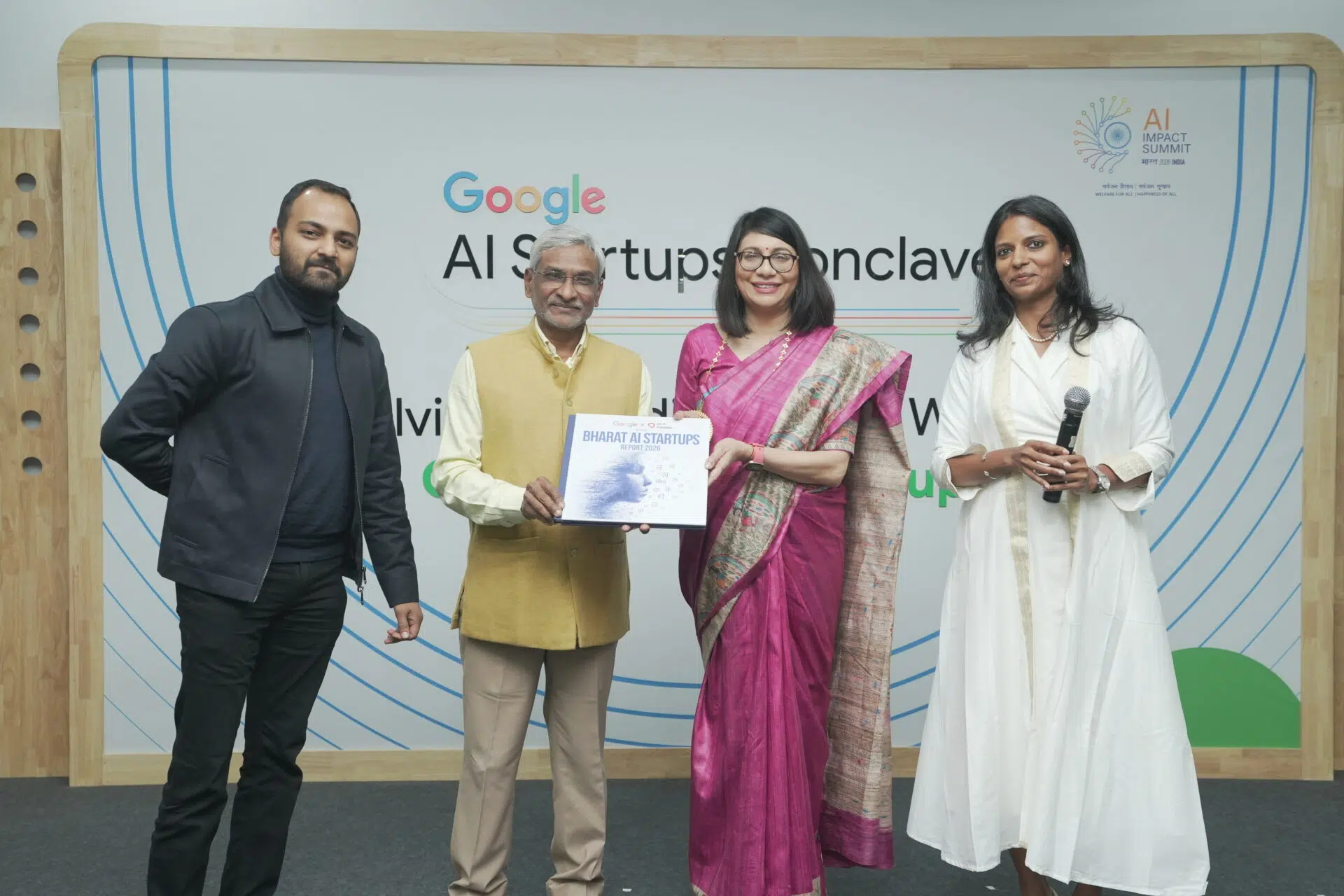
At the Google AI Startups Conclave held in New Delhi on January 15, 2026, Google laid out a fairly ambitious vision for how Indian AI startups can move beyond local pilots and into sustained global operations. The announcements were not just about models or funding, but about something founders often struggle with quietly: turning strong technology into long-term international business. In that context, Google introduced several new initiatives that, taken together, aim to address scale, credibility, and access.
One of the headline announcements was the launch of the Google Market Access Program, which Google described as a first-of-its-kind effort. The goal here is to close the gap between technical proof-of-concept projects and real enterprise contracts that last beyond initial experimentation. Alongside this program, Google also expanded its open-source Gemma model family, adding specialized tools for healthcare and on-device automation. These updates come at a time when India’s AI market is projected to reach $126 billion by 2030, and when nearly half of Indian enterprises are already pushing AI projects into full production environments. That timing does not seem accidental.
Key Takeaways
- Market Access Program: A new initiative designed to help Indian startups secure global enterprise contracts. It combines structured training with direct networking opportunities involving international executives.
- MedGemma 1.5: An advanced open-source AI model tailored for medical diagnostics, with the ability to analyze complex 3D medical scans such as MRIs and CT scans.
- FunctionGemma: A lightweight AI model that enables agents to operate directly on mobile devices, without needing constant internet access.
- Economic Impact: India’s AI sector is expected to grow to $126 billion by 2030, with the potential to contribute as much as $1.7 trillion to national GDP by 2035.
- Infrastructure Support: Google continues to scale its 1-gigawatt AI Hub in Visakhapatnam, offering high-performance computing resources to Indian founders.
Turning Prototypes Into Global Deals
For many startups, building a working product is only half the battle. Selling that product to large, global enterprises is often where momentum slows. Google’s Market Access Program is clearly aimed at this exact friction point. The program offers a specialized curriculum that covers international buyer psychology, enterprise procurement cycles, and pricing models that are often unfamiliar to early-stage founders.
Beyond classroom-style learning, the program also focuses heavily on access. Startups get direct introductions to a global network of Chief Information Officers, which, in practice, can shorten sales cycles that would otherwise take years. Partners such as TiE Silicon Valley and Alteus are involved to help Indian founders establish in-person relationships in major technology hubs. That face-to-face element may sound traditional, but it still matters, perhaps more than many founders expect, when trust and scale are on the line.
Specialized AI Models for Health and Mobile
Google’s work on the Gemma model family reflects a deeper push into domain-specific AI. MedGemma 1.5, in particular, stands out because it is built specifically for healthcare use cases. It is a 4-billion parameter open-source model designed to process high-dimensional medical data, including whole-slide histopathology images and longitudinal chest X-ray studies. These are not simple image tasks, and accuracy here is not optional.
MedGemma 1.5 is already being used in collaboration with the All India Institute of Medical Sciences to help build India’s Health Foundation Models. That partnership suggests Google is thinking long-term, not just about publishing models, but about embedding them into national-scale health infrastructure.
On the mobile side, FunctionGemma takes a different but equally practical approach. It allows developers to build AI agents that run directly on a user’s phone. Because the model is optimized for function calling, it can convert natural language commands into concrete actions on the device, such as setting reminders or searching local files. Importantly, this processing happens locally, which improves privacy and allows apps to function even on low-end devices or in areas with unreliable connectivity. In India, that constraint is not theoretical. It is daily reality.
Building the Physical and Data Foundation
None of these software initiatives work at scale without serious infrastructure behind them. Google’s Global AI Hub in Visakhapatnam, Andhra Pradesh, is central to this effort. The 1-gigawatt facility is powered by green energy and houses Google’s advanced Tensor Processing Units. For Indian startups, this means access to the same class of computing power used by global technology leaders, without having to build that infrastructure themselves.
Google is also addressing what many consider one of India’s biggest AI bottlenecks: data. Project Vaani, a collaboration with the Indian Institute of Science, has completed its second phase and released more than 27,000 hours of speech data across 100 Indian languages. This data is freely available, and its value goes beyond language recognition. It allows startups to build AI systems that understand India’s linguistic and cultural diversity, which in turn creates products that are resilient and adaptable in global markets.
There is a recurring idea that came up throughout the conclave, sometimes explicitly and sometimes between the lines. If an AI system can work reliably across India’s varied languages, accents, and network conditions, then it is probably strong enough to work anywhere. That is what many now refer to as the “Bharat-tested” standard.
Frequently Asked Questions
Q1: How can my startup apply for the Google Market Access Program?
A1: Applications are currently open on the Google for Startups website. Eligible startups must be based in India, have an AI product that goes beyond the prototype stage, and be prepared to scale into international markets.
Q2: What makes MedGemma 1.5 different from other AI models?
A2: MedGemma 1.5 is fine-tuned specifically for medical accuracy. Unlike general-purpose models, it can analyze 3D volumes from CT and MRI scans and track changes in medical images over time, which is essential for monitoring disease progression.
Q3: Can FunctionGemma work on a phone without the internet?
A3: Yes. FunctionGemma is designed for on-device inference, meaning AI processing happens directly on the phone’s hardware. This allows for private, offline execution of tasks.
Q4: What does the “Bharat-tested” standard mean?
A4: The “Bharat-tested” standard refers to AI systems that can operate reliably across India’s linguistic diversity and inconsistent connectivity. The idea is that if a product works well under these conditions, it is likely robust enough for global deployment.