

Samsung Electronics has revealed key architectural details for its eighth-generation foldable lineup, explaining how hardware changes reduce screen crease visibility and body thickness across the Galaxy Z Fold8 Ultra, Galaxy Z Fold8, and Galaxy Z Flip8. The South Korean technology firm, which introduced the new lineup on July 22, detailed the internal construction during an engineering briefing in Gurugram, India. Sunghoon Moon, executive vice president of mobile hardware research at Samsung Electronics, explained that the company redesigned its hinge, display module, cooling, and battery layout as a single connected system to make the phones slimmer without reducing overall durability.
Key Takeaways
- Samsung introduced the Galaxy Z Fold8 Ultra, Galaxy Z Fold8, and Galaxy Z Flip8 with thinner display profiles.
- Flex Titanium technology combines a titanium base plate with a titanium-alloy film to cut display thickness by 10%.
- The Galaxy Z Fold8 Ultra features a 5,000 mAh silicon-carbon battery with 45W fast wired charging.
- A dual-path charging system allows the top model to reach a 67% battery level in 30 minutes.
- Samsung completed more than 100 mechanical and environmental tests to test resistance to drops, moisture, dust, and continuous folding.
Flex Titanium and Display Changes
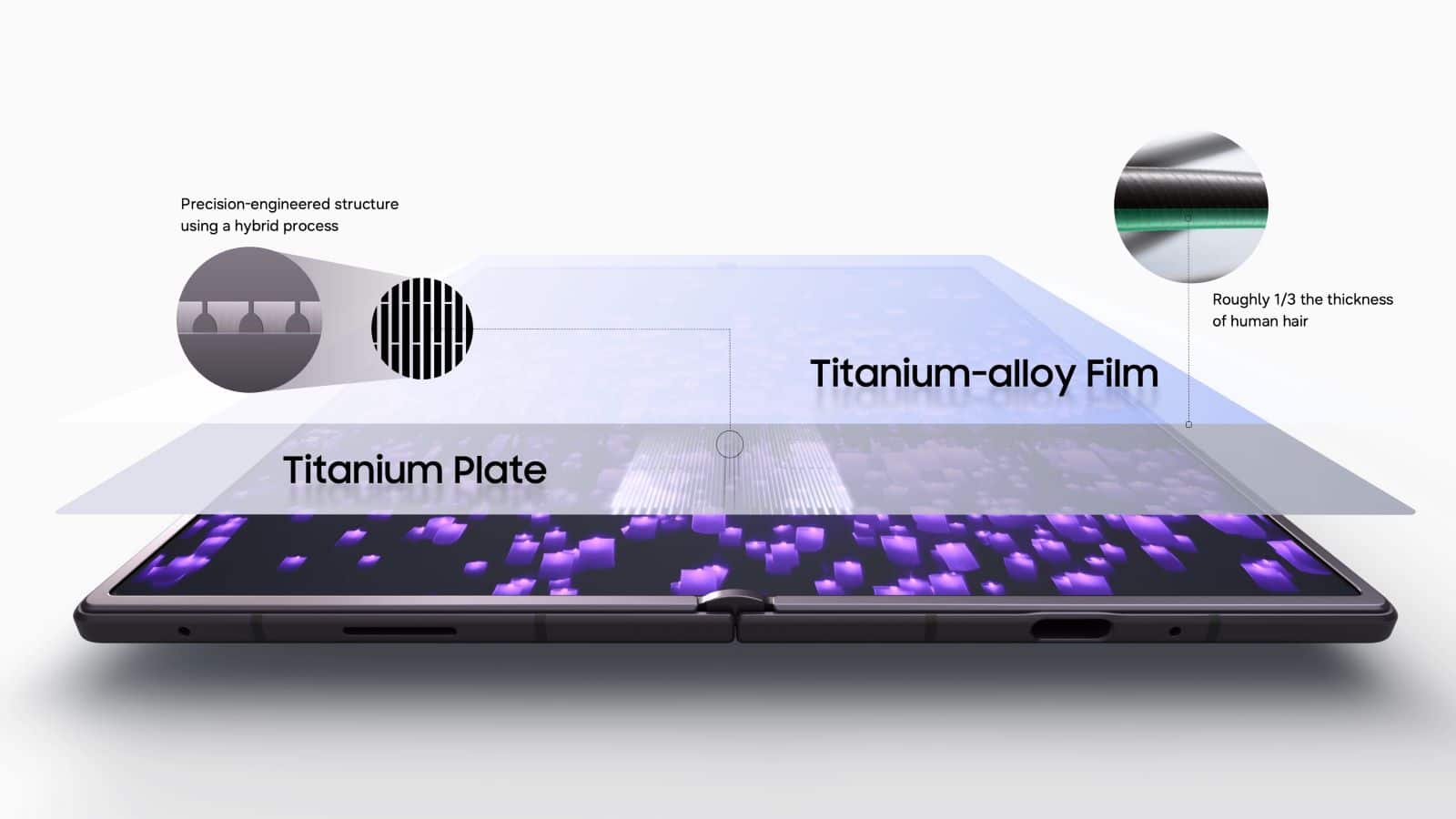
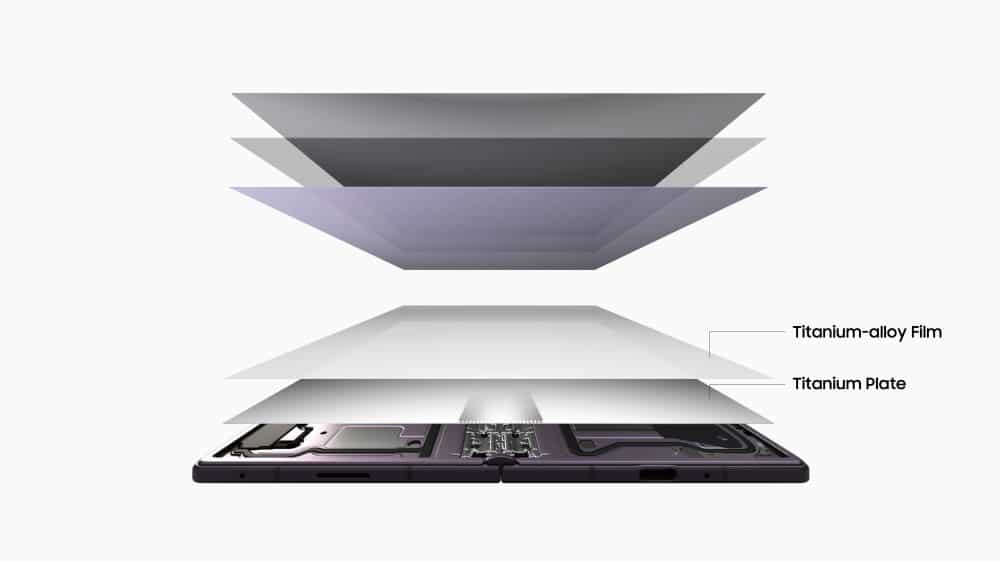
To reduce the physical footprint of the phone screen, Samsung developed Flex Titanium. The assembly uses two primary metal elements placed directly below the folding OLED panel. A bottom titanium plate features a precision lattice pattern to deliver structural rigidity when flat while allowing smooth flexibility along the central bend. Directly above that plate sits a flexible titanium-alloy film designed to maintain elastic recovery through hundreds of thousands of fold cycles.
Moon stated that replacing older layer materials with titanium cut the overall display module thickness by 10%. The thinner panel assembly reduces the visible crease down the center of the inner screen and frees up physical clearance inside the chassis for the cooling chamber, camera modules, and larger battery cells.
Silicon-Carbon Battery and Dual-Path Charging
Samsung upgraded the battery architecture in the flagship Galaxy Z Fold8 Ultra to supply steady power without expanding chassis thickness. The device houses a 5,000 mAh capacity cell built using a silicon-carbon anode, a chemistry choice that delivers higher energy density compared to standard graphite anodes.
Both the Galaxy Z Fold8 Ultra and the regular Galaxy Z Fold8 incorporate a dual-path power architecture. This design divides incoming electrical current across separate channels to regulate heat during high-speed top-ups. Using a 45W wired adapter, the Galaxy Z Fold8 Ultra charges from flat to 67% in 30 minutes.
Samsung confirmed that all models underwent more than 100 quality control and durability tests, including automated drop testing, pressure checks, exposure to moisture, dust penetration trials, and extended mechanical folding stress tests.
Frequently Asked Questions
Q1. What devices are included in the Samsung Galaxy Z Fold8 generation?
A1. The lineup includes the Galaxy Z Fold8 Ultra, the standard Galaxy Z Fold8, and the compact Galaxy Z Flip8.
Q2. What is Samsung Flex Titanium technology?
A2. Flex Titanium is a display support architecture using a lattice-cut titanium plate and a flexible titanium-alloy film under the screen to cut display thickness by 10% and reduce crease visibility.
Q3. What is the battery capacity and charging speed of the Galaxy Z Fold8 Ultra?
A3. The Galaxy Z Fold8 Ultra includes a 5,000 mAh silicon-carbon battery that supports 45W charging, reaching 67% charge in 30 minutes.
Q4. How did Samsung test the durability of the Galaxy Z Fold8 series?
A4. Samsung put the devices through over 100 physical reliability checks covering drops, repeated folding, water, dust, and continuous pressure.