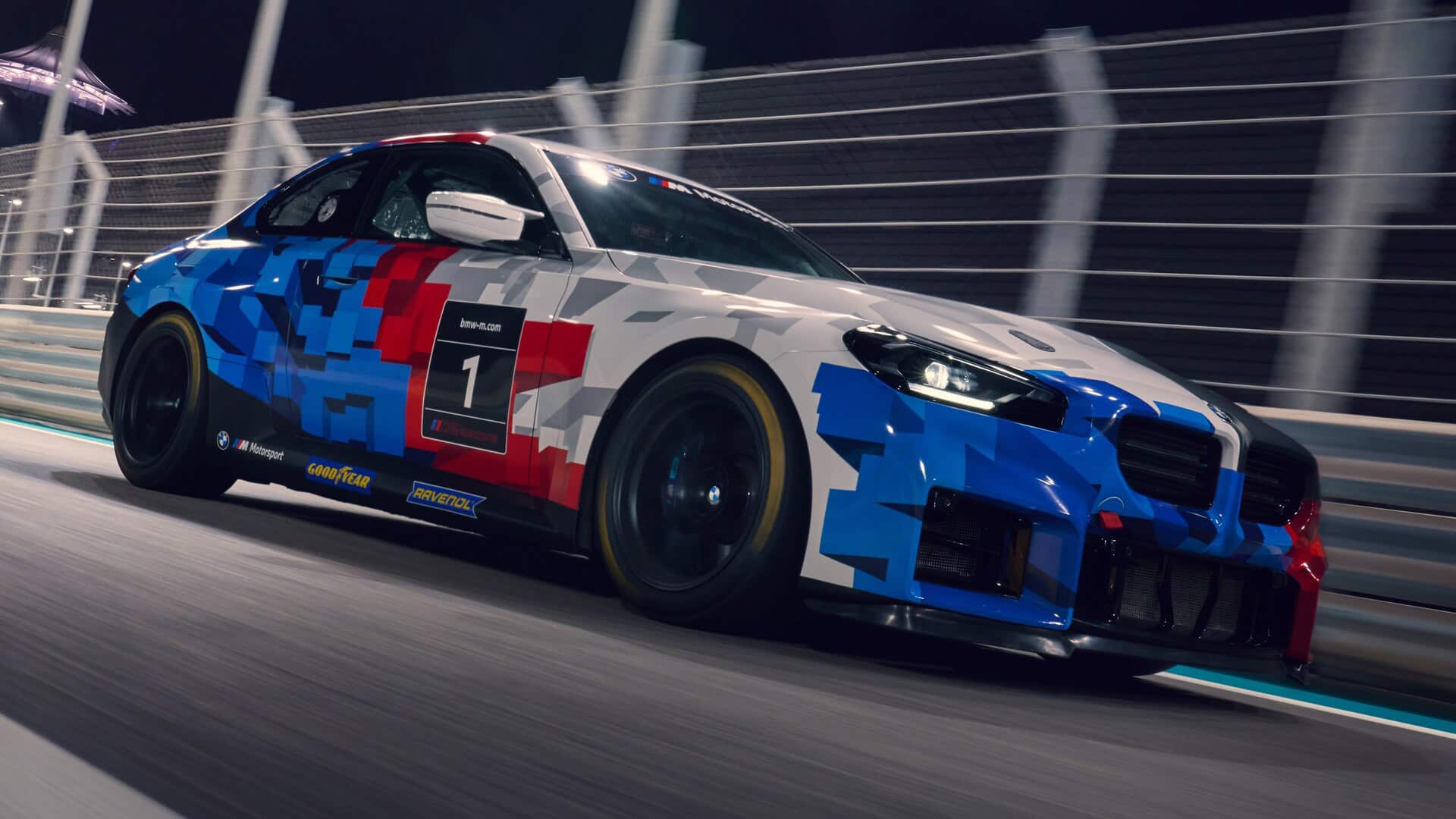
BMW M Motorsport just pulled a fast one, revealing a brand-new customer racing car set to hit tracks in the 2026 season. It’s based on the current G87 generation M2, and while everyone might have expected a race-prepped version of the road car’s potent inline-six, BMW went in a surprisingly nostalgic, yet incredibly exciting, direction. Get ready, because this new M2 racer packs a four-cylinder engine, echoing the spirit of the legendary E30 M3.
For years, BMW’s customer racing efforts in the M2 platform have centered around the M2 CS Racing. This has been a highly successful machine, powered by the S55 twin-turbocharged inline-six engine, delivering up to 450 horsepower depending on the specific racing series’ Balance of Performance requirements. It’s a powerful, proven package that has seen action in various championships around the globe, offering amateur and professional teams a potent entry into GT4 and touring car racing.
Naturally, when whispers of a new M2 race car emerged, the assumption was it would carry forward with a variant of the G87 road car’s S58 inline-six. It’s the logical progression, right? Take the already formidable six-cylinder from the street car, strip weight, add safety gear, hone the aero, and prepare it for battle. But BMW M Motorsport clearly had a different vision, one that seems deeply rooted in their rich racing history.
The newly unveiled car, simply called the BMW M2 Racing, features a turbocharged 2.0-liter inline-four engine. Yes, you read that correctly. A four-cylinder. Codenamed internally as based on the B48 engine family, this racing variant produces 313 horsepower (230 kW) and 420 Nm of torque. While these numbers might seem modest compared to the M2 CS Racing’s six-cylinder figures, particularly to those accustomed to the street G87 M2’s substantial 473 horsepower from its S58 engine, they tell only part of the story.
This decision is anything but a step backward. Instead, it feels like a deliberate and exciting nod to one of BMW’s most iconic racing machines: the original E30 M3. The E30 M3, the car that built BMW M’s formidable reputation in touring car racing, was powered by a high-revving, naturally aspirated four-cylinder engine, the S14. That 2.3 or 2.5-liter four-banger, derived from a Formula 1 engine block design, was the heart and soul of the E30 M3’s success. It was lightweight, responsive, and loved to be pushed hard – characteristics that made the E30 M3 a legend on the track.
By choosing a four-cylinder for the new M2 Racing, BMW M Motorsport is seemingly aiming to replicate some of that original M3 magic. A smaller, lighter engine typically means better weight distribution and overall reduced mass, crucial factors for agility and handling on a race track. While the new engine is turbocharged, unlike the S14, the focus on a four-cylinder architecture for a compact, rear-wheel-drive coupe racer directly mirrors the philosophy behind the E30 M3.
BMW M Motorsport states the new M2 Racing is designed as an entry point into customer racing, emphasizing low operating costs and ease of maintenance – qualities that were also key to the E30 M3’s widespread adoption by privateer teams in its era. The car utilizes a 7-speed ZF automatic transmission with specialized motorsport software and features a mechanical differential lock with separate cooling, similar to the M2 CS Racing but adapted for the new powertrain. It also comes equipped with motorsport-specific ABS and adjustable traction control, a welded safety roll cage, and KW adjustable dampers (initially non-adjustable based on early specs, but racing applications often allow for tuning). The top speed is quoted as over 270 km/h.
The change in engine might initially surprise those expecting the inline-six, but for anyone familiar with BMW M’s heritage, it’s a move that sparks a sense of connection to the past. The E30 M3 wasn’t about brute straight-line power; it was about balance, responsiveness, and a direct connection between driver and machine, amplified by that buzzing, potent four-cylinder. The new M2 Racing, with its focus on a compact four-cylinder package, appears to be channeling that same philosophy.
This isn’t just a race car; it’s a statement. It shows BMW M Motorsport isn’t afraid to look back at what made them successful and reinterpret it for the modern era of customer racing. It’s a strategic move to offer a different kind of racing experience compared to the six-cylinder M2 CS Racing, potentially opening up new avenues and series for teams. The lower horsepower figure from the four-cylinder doesn’t mean it will be slow or uncompetitive; racing success is about the entire package – chassis, aero, tires, driver, and how well the powertrain integrates with everything else. The B48 is a robust and tunable engine in its production form, and its motorsport adaptation is likely built for durability and consistent performance under racing loads.
Teams looking for a cost-effective, engaging, and historically resonant racing platform will likely find the new BMW M2 Racing incredibly appealing. It’s a car that demands driver input and rewards precision, much like its spiritual ancestor, the E30 M3. While the S58-powered M2 CS Racing remains a formidable option, the introduction of the four-cylinder M2 Racing adds an exciting new dimension to BMW’s customer motorsport program, one that proudly salutes its legendary past while looking firmly towards the future of accessible, thrilling competition. This unexpected engine choice isn’t just news; it’s a revival of a winning formula.