

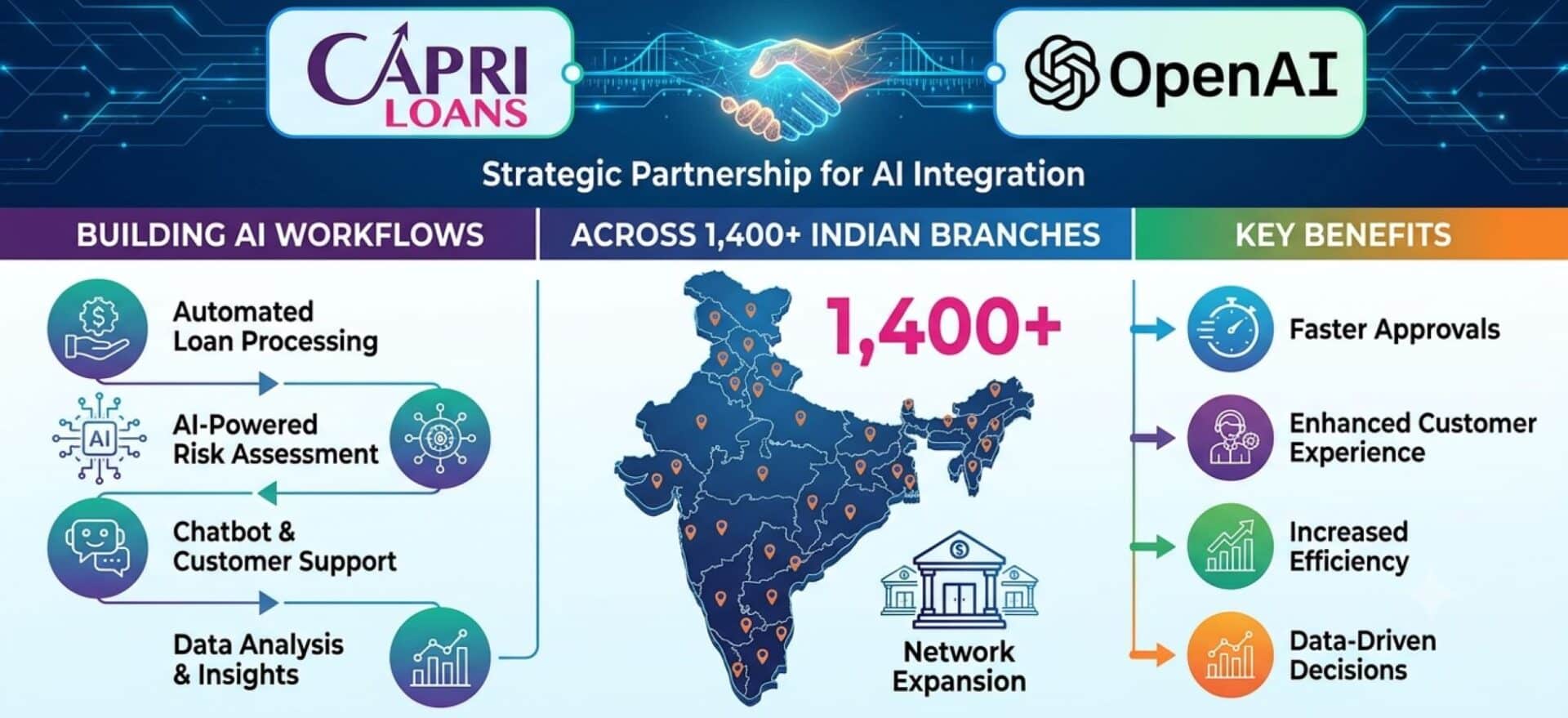
Mumbai-based non-banking financial company Capri Global Capital Limited, known as Capri Loans, announced on July 29, 2026, a collaboration with OpenAI to introduce enterprise artificial intelligence into its core lending operations. The initiative will introduce specialized software tools across its network of over 1,400 branches in India, targeting improvements in customer service, knowledge management, and daily operational processes for its 7.6 lakh customers.
Key Takeaways
- Capri Loans collaborates with OpenAI to deploy enterprise artificial intelligence across its branch network in India.
- Initial focus areas include document processing, policy search, application support, and early-warning risk systems.
- Human credit managers and proprietary credit models retain complete control over all underwriting decisions.
- Deployment will proceed in phases while adhering to strict data privacy and financial regulatory guidelines.
Target Areas and Technology Application
Capri Loans, a retail lender listed on the Bombay Stock Exchange and National Stock Exchange, holds assets under management exceeding Rs 40,000 crore as of June 30, 2026. The company operates in four primary lending categories: gold loans, MSME loans, construction finance, and housing loans, the latter managed through its subsidiary Capri Global Housing Finance Limited. It also runs fee-based businesses, including car loan distribution through Capri Loans Car Platform Private Limited and insurance distribution.
Through this project, the lender aims to assist its 13,700 employees by automating routine desk tasks. The initial focus will involve evaluating tools for document and information analysis, quick retrieval of internal policy guidelines, customer application processing support, exception handling, and early-warning signal processing. These tools will help relationship managers and branch staff synthesize multi-source information faster during routine customer interactions.
Governance and Risk Controls
Despite adopting artificial intelligence in operational workflows, Capri Loans clarified that underwriting and credit approvals will not rely on automated machine output. The lender’s proprietary credit assessment models, internal underwriting rules, and risk management guidelines will continue to direct all final loan decisions through human credit officers.
“Our collaboration with OpenAI will help us deploy practical use cases across the lending value chain, while maintaining high standards of governance, security, and human oversight,” said Rajesh Sharma, Managing Director of Capri Global Capital Limited.
OpenAI, creator of enterprise artificial intelligence models, emphasized the practical value of automated information processing in financial settings. Nitin Bawankule, Head of Enterprise Sales for OpenAI in India, noted that the deployment aims to help branch teams handle large volumes of technical data faster while maintaining human oversight at every step.
The company plans a phased rollout structured around role-based access controls, continuous monitoring, and strict adherence to Indian regulatory standards. Customer data privacy will remain governed under existing security protocols and consent management rules.
Frequently Asked Questions
Q1. What is the partnership between Capri Loans and OpenAI about?
A1. Capri Loans is collaborating with OpenAI to deploy enterprise artificial intelligence tools across its 1,400 branches to help staff analyze documents, search policy knowledge, and handle customer applications faster.
Q2. Will OpenAI tools make loan approval decisions for Capri Loans?
A2. No. Capri Loans stated that human officers and proprietary credit models will make all underwriting and loan approval decisions.
Q3. Which loan products does Capri Loans offer in India?
A3. Capri Loans provides gold loans, MSME loans, construction finance, housing loans, and car loan distribution across India.
Q4. How will customer data privacy be protected during this rollout?
A4. The deployment uses role-based access control and strict data security protocols complying with standard regulatory guidelines and existing customer consent standards.