

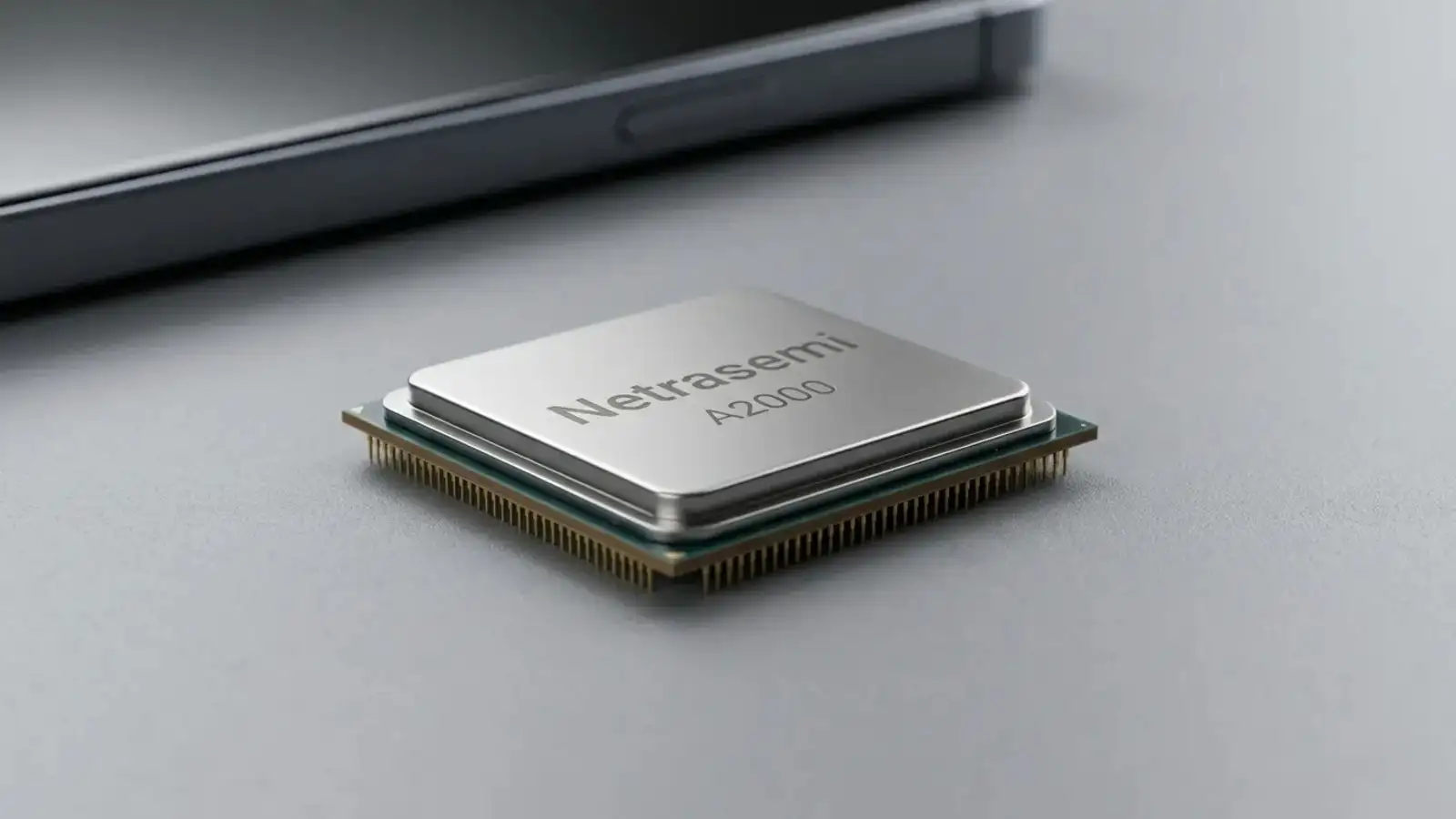
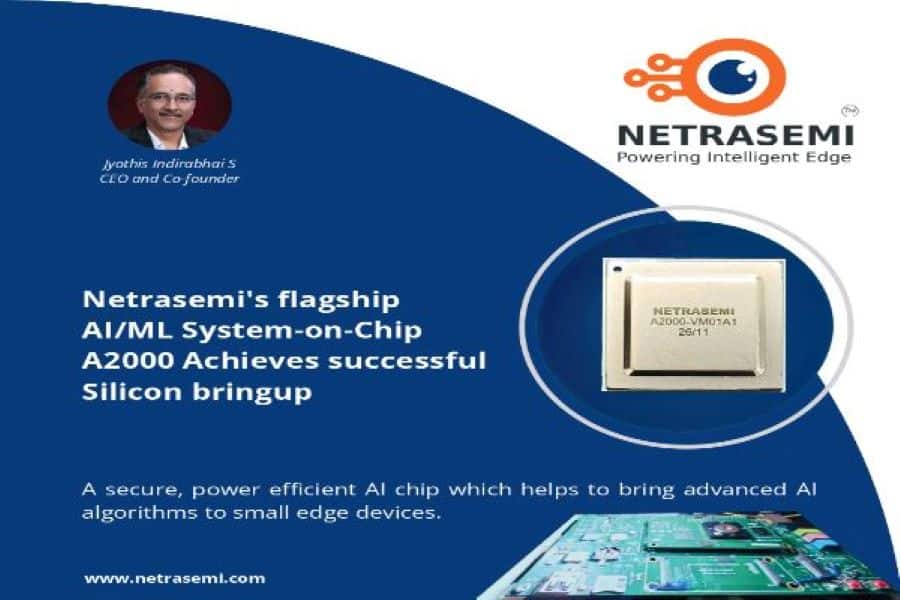
Netrasemi, an Indian semiconductor startup, just launched its flagship AI chip, the A2000. It’s a big deal for India’s fabless chip scene. The chip passed its silicon bringup, so the hardware works as planned after being made at TSMC in Taiwan on a 12nm process. The A2000 is built for edge devices. That means smart cameras and industrial tools can process video right on the device, no need to send everything to the cloud.
Key Takeaways
- Production Timeline: Commercial production is expected to begin in 2027 at the TSMC facility.
- Funding Status: The company has secured Rs 125 crore in total funding from major investors like Zoho and Unicorn India Ventures.
- Technical Specs: Built on a 12nm node, featuring an in-house Neural Processing Unit (NPU) and patented parallel processing architecture.
- Target Sectors: The chip will be used in drones, CCTV surveillance, robotics, and industrial automation.
- Government Support: Netrasemi is a beneficiary of the Design Linked Incentive (DLI) scheme by the Ministry of Electronics and Information Technology (MeitY).
Powering the next generation of smart vision
The A2000 is among the first AI/ML chips designed in India to feature a complete array of in-house digital intellectual property (IP). This includes a custom Image Signal Processor (ISP) for high quality video and specialized Vision Cores (VPU). By using a patented Heterogeneous graph-stream parallel processing architecture, the chip handles complex AI algorithms while remaining power efficient for small, compact devices.
Jyothis Indirabhai, CEO of Netrasemi, noted that the architecture is tailored for cost-sensitive edge devices. The company is already sharing designs with global original equipment manufacturers (OEMs) for joint research and development to create new commercial use cases. This collaboration helps integrate the chip into future smart cameras and video gateways.
Expanding the Indian semiconductor footprint
Beyond the A2000, Netrasemi is broadening its portfolio through academic and government partnerships. In a joint effort with the College of Engineering Trivandrum (CET), the startup developed the R1000 AI/ML MCU for the IoT sensor market, which went for fabrication last month. Additionally, work has started on a more powerful A4000 Edge AI server chip, expected to be ready for fabrication by the second quarter of 2027.
The support from MeitY has been instrumental, with the company being one of the first four startups selected for the Rs 15 crore DLI support in 2023. This government backing, combined with private investment, has positioned the Thiruvananthapuram-based firm as a key player in India’s attempt to become a global hub for semiconductor design.
Frequently Asked Questions
Q1. What makes the Netrasemi A2000 different from standard processors?
A1. Unlike general processors, the A2000 includes dedicated hardware like an NPU and VPU specifically for AI and video tasks. Its patented architecture allows it to run advanced AI algorithms locally on small devices with very low power consumption.
Q2. When will devices using this Indian AI chip be available in the market?
A2. The chip is scheduled for commercial volume production in 2027. Before that, the company is working with OEMs on early sample testing and co-development throughout 2026.
Q3. Which industries will benefit most from this technology?
A3. Key sectors include security (smart CCTV and drones), industrial automation, and robotics. It is particularly useful for any application that requires real-time video analytics without relying on external servers.