

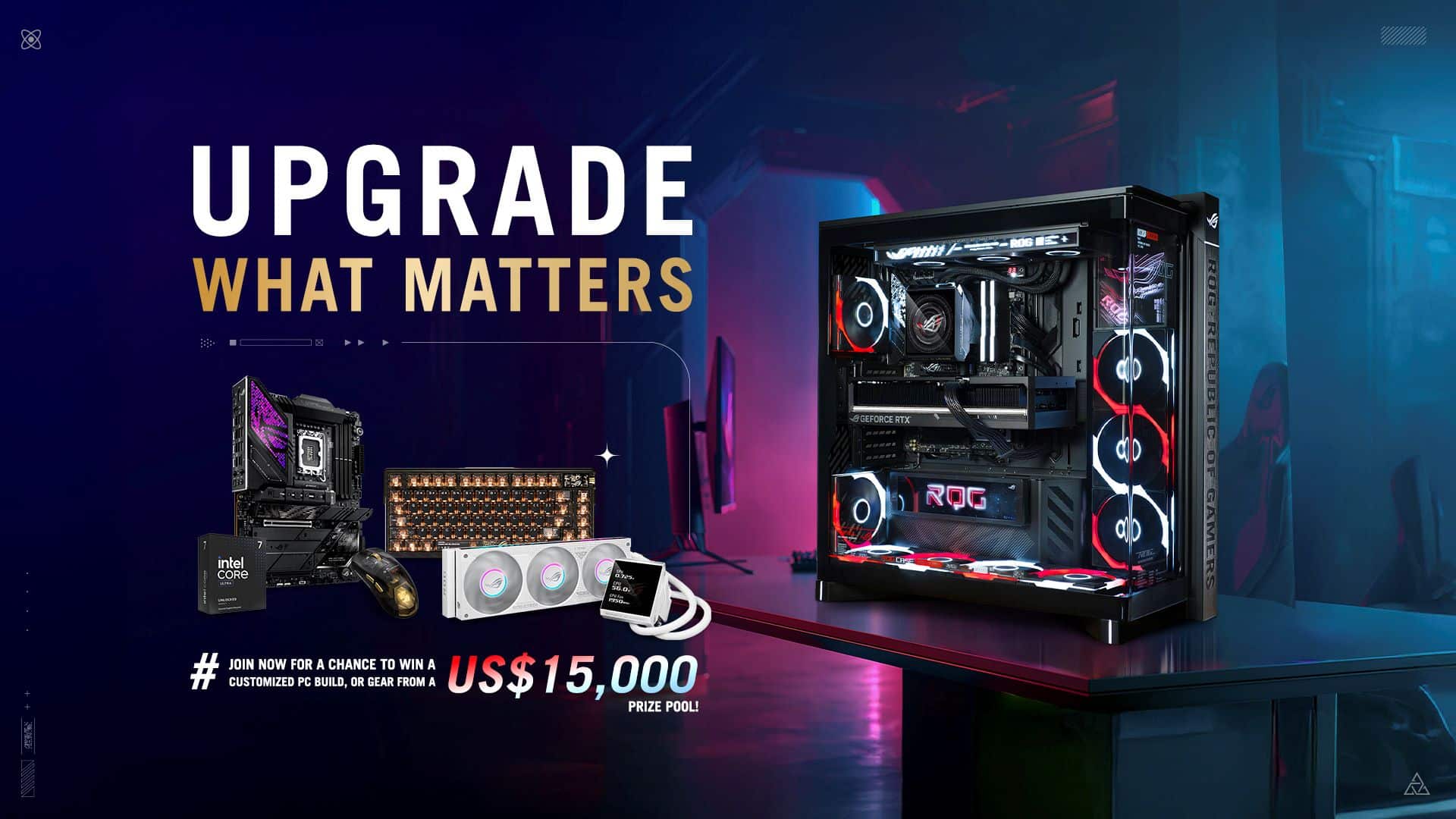
Hardware manufacturer ASUS published a comprehensive guide outlining practical strategies for building and upgrading desktop personal computers amid ongoing memory supply challenges. High memory prices continue to affect PC builders, prompting ASUS to detail specific steps to keep expenses down while assembling systems for gaming, content creation, and agentic AI workloads. The company paired the guide with an “Upgrade What Matters” giveaway running through Dec. 31, 2026, offering hardware prizes from a pool valued at $15,000.
Key Takeaways
- Buyers can lower initial memory expenses by using combo deals, buying prebuilt desktops with standard parts, or starting with basic DDR5 memory configurations to upgrade later.
- ASUS motherboards include firmware tools such as DIMM Fit, DIMM Flex, and AEMP Mix Tuning to stabilize non-ideal and mixed RAM setups.
- Builders face a choice between Intel Core Ultra Series 2 processors on Z890 or B860 chipsets and AMD Ryzen 9000 Series chips on X870E, X870, or B850 boards.
- GPU selection depends on VRAM capacity, ranging from 8GB cards for budget 1080p gaming to 32GB cards for complex multi-agent AI environments.
Memory buying tactics for builders Rising standalone RAM prices make memory procurement a primary hurdle for buyers. To keep costs manageable, ASUS recommends purchasing bundled component packages that package memory with processors and motherboards. Another practical route involves purchasing prebuilt systems that follow standard form factors, such as the ROG G700 series, which allows users to swap graphics cards and add memory over time without paying inflated standalone component premiums.
Motherboard hardware tools and memory tuning Modern DDR5 memory kits introduce signal integrity and thermal challenges. ASUS motherboards address these hurdles with proprietary tuning tools. Technologies like DIMM Fit and DIMM Flex assist in stabilizing frequencies and tight timings. On Intel 800-series motherboards, AEMP Mix Tuning lets users run mismatched RAM modules from different vendors while automatically applying stable performance profiles. Premium boards also feature NitroPath DRAM technology to enhance signal transfer across memory slots.
Platform comparison between Intel and AMD For Intel builds, the LGA 1851 socket supports Intel Core Ultra Series 2 processors. High-end users can pair chips like the Core Ultra 270K Plus with Z890 motherboards for processor overclocking, while mainstream buyers can opt for the B860 chipset paired with processors such as the Core Ultra 250K Plus.
AMD options center on the AM5 socket, which supports AMD Ryzen 9000 Series processors alongside future platform upgrades. Enthusiasts can opt for X870 and X870E motherboards paired with gaming processors like the Ryzen 7 9800X3D and Ryzen 9 9950X3D. Mainstream builders can select B850 boards, which maintain both CPU and memory overclocking capabilities. Budget-conscious builders can also choose older AM4 B550 boards to take advantage of lower-cost DDR4 memory.
Graphics card requirements for gaming and artificial intelligence Choosing a dedicated graphics card requires matching VRAM to software demands. For standard 1080p gaming and light tasks, 8GB GPUs like the NVIDIA GeForce RTX 5050, RTX 5060, or AMD Radeon RX 9060 XT offer entry points. Smooth 1440p gaming and moderate visual processing call for 16GB cards such as the RTX 5060 Ti, RTX 5070, or Radeon RX 9070. Users running local agentic AI models or large fleets of AI agents require 32GB graphics cards like the GeForce RTX 5090, ASUS UGen Intel Arc Pro B70, or ASUS Turbo Radeon AI Pro R9700.
Related FAQs
Q1. Why are PC memory costs elevated in 2026?
A1. Increased demand for high-speed memory across enterprise and consumer sectors has kept DDR5 prices high, making memory a larger portion of total PC build costs.
Q2. What is ASUS AEMP Mix Tuning?
A2. AEMP Mix Tuning is an ASUS BIOS feature for Intel 800-series motherboards that automatically tunes and stabilizes mismatched RAM sticks from different brands.
Q3. How much VRAM is needed for running local AI agents?
A3. While single models run on 8GB or 16GB cards, managing multiple active agents and large context data requires GPUs with up to 32GB of VRAM.
Q4. Which motherboard chipset suits mainstream AMD Ryzen 9000 builds?
A4. The AMD B850 chipset offers full AM5 compatibility, CPU and RAM overclocking, and modern connectivity at a lower price point than X870 motherboards.