

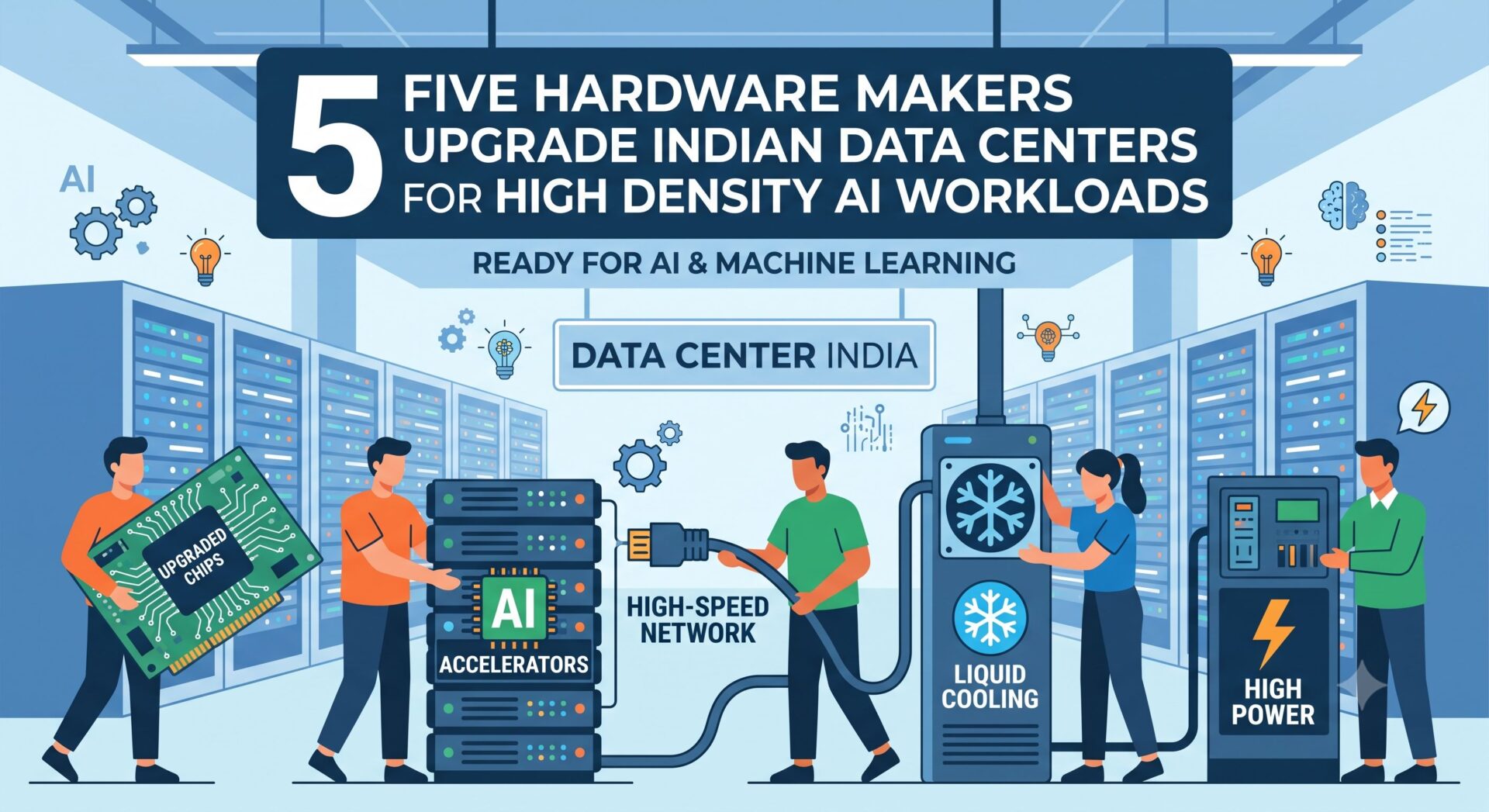
Indian data centers face a major physical overhaul as generative AI and large language models push rack power demands from standard 5 to 10 kW levels up to 30 to 100 kW. These high compute loads produce extreme thermal stress that traditional air conditioning units cannot cool, creating risks of thermal throttling and electrical grid disruptions across facilities. To solve these operational issues, facility operators in India work with five core infrastructure manufacturers: Delta Electronics India, Eaton India, Stulz India, Rittal India, and CoolIT Systems.
Key Takeaways
- Power Jump: AI GPU clusters demand 30 to 100 kW per rack, making standard computer room air handlers obsolete.
- Liquid Cooling: Direct-to-chip cooling loops and fluid distribution units replace conventional forced-air systems.
- Power Stability: Heavy-duty uninterruptible power supply systems and smart switchgear buffer sudden model training load spikes.
- Structural Upgrades: Specialized high-capacity server enclosures support the increased physical weight of fluid-filled GPU nodes.
Cooling and Power Delivery Upgrades
Delta Electronics India produces megawatt-scale power shelves, high-efficiency uninterruptible power supply (UPS) units, and liquid-to-liquid as well as liquid-to-air cooling distribution units. These setups direct liquid coolant straight to high thermal design power (TDP) processors, keeping Power Usage Effectiveness (PUE) metrics low during peak operational phases.
Eaton India focuses on electrical stability by supplying high-density power distribution units (PDUs), energy-storage-ready UPS setups, and smart switchgear. These devices buffer sudden voltage drops caused by intensive AI model training and help integrate renewable energy into high-density facilities.
Thermal Management and Heavy Duty Enclosures
Stulz India provides precision cooling equipment, high-capacity chillers, and custom direct-to-chip fluid loops. Their infrastructure helps facility operators transition from older hybrid air-water systems to direct liquid cooling setups.
Rittal India manufactures modular server racks and climate-controlled enclosures engineered to carry heavy GPU nodes loaded with liquid pipes. The sealed designs route cooling lines inside the frame to maximize floor space.
CoolIT Systems supplies direct-contact cold plates, distribution manifolds, and heat exchangers that sit directly on top of server silicon. These loops prevent thermal throttling when server densities exceed 100 kW.
Frequently Asked Questions
Q1. Why are traditional Indian data centers upgrading for AI?
A1. Standard data centers run on 5 to 10 kW per rack. Modern generative AI server racks need between 30 and 100 kW, generating heat that air conditioning systems cannot remove.
Q2. What is direct-to-chip liquid cooling?
A2. Direct-to-chip cooling routes liquid through cold plates placed directly on processors to remove heat faster than conventional air cooling.
Q3. How do AI workloads affect power grids?
A3. AI training causes sudden electrical surges. Hardware like smart switchgear and high-capacity UPS units manage these fluctuations to protect electrical equipment from voltage sags.