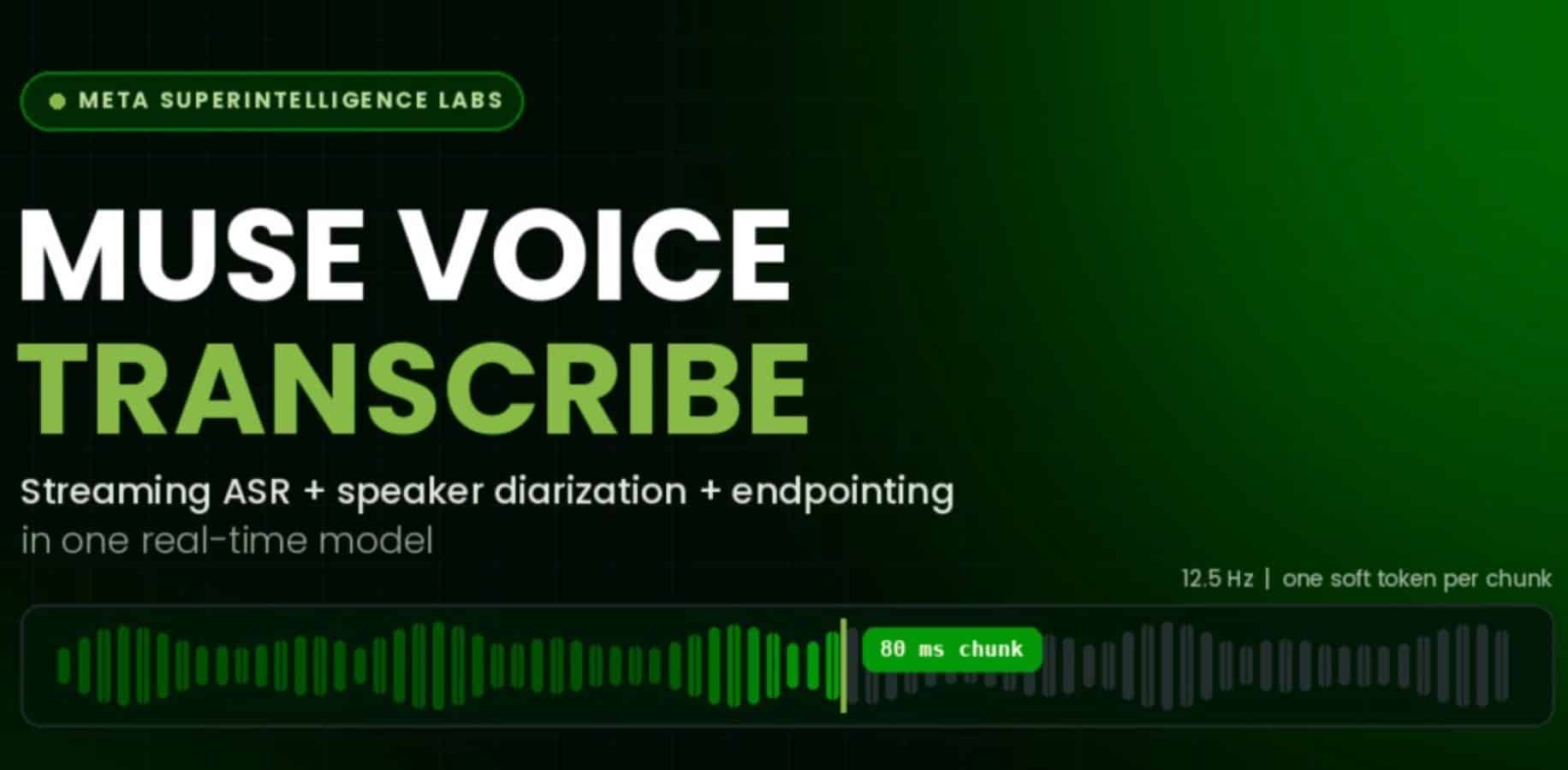
Meta Superintelligence Labs has released Muse Voice Transcribe, its first real-time audio perception model built to convert live speech directly into text without separate post-processing steps. The system separates more than 20 distinct speakers in recordings lasting over an hour while simultaneously managing native language transitions. As of Sept. 1, 2026, the model ranks first on the Artificial Analysis streaming speech-to-text benchmark leaderboard with a 3.1 percent word error rate.
Key Takeaways
- Single model handles streaming transcription, speaker separation, and speech boundaries without external add-ons.
- Ranks top on the Artificial Analysis streaming leaderboard with a 3.1 percent word error rate.
- Trained across 70 plus languages with 25 verified at launch, including major Indian languages like Hindi, Tamil, and Telugu.
- Employs adaptive delay to vary listening windows on difficult vocabulary rather than applying fixed speed constraints.
- Accessible globally via the Meta Model API at $3.00 per 1,000 audio minutes ($0.18 per hour).
Unified Speech Architecture
Traditional speech pipelines typically divide workloads across several tools. One system transcribes raw audio, a second labels who spoke, and a third identifies where sentences end. Muse Voice Transcribe carries out all three tasks in one pass. It processes sound in 80-millisecond chunks, translating each chunk into an internal soft token.
Instead of using a static latency setting, the system relies on an adaptive delay mechanism. Clear words publish quickly, while complex words prompt the model to listen slightly longer before outputting text. This avoids premature errors on difficult phrases while preserving low latency on simple ones.
Language Handling and Speaker Recognition
The software targets multilingual speakers who often mix languages mid-sentence. In India and across multilingual communities, speakers regularly blend English with regional tongues such as Hindi, Tamil, Telugu, Kannada, and Malayalam. Muse Voice Transcribe handles these shifts natively without losing speaker continuity.
During group meetings, the system tracks up to 20 speakers across conversations extending past 60 minutes. This capability allows corporate teams and software developers to generate labeled transcripts while discussions happen live.
Pricing and Availability
Meta has integrated the model into its consumer and developer tools. Muse Voice Transcribe operates the system-wide dictation feature in the Meta AI desktop app for Mac and accepts voice commands inside Muse Code, Meta’s software development assistant.
External developers can integrate the model through the Meta Model API under the identifier muse-voice-transcribe-1.0. The service costs $3.00 per 1,000 audio minutes, which translates to $0.18 per audio hour (roughly 15 Indian rupees per hour at current exchange rates). The API uses OpenAI SDK-compatible endpoints, which reduces setup friction for engineering teams. Unlike Meta’s open-weights Llama software, Muse Voice Transcribe remains hosted exclusively via cloud endpoints.
Frequently Asked Questions
Q1. What is Muse Voice Transcribe?
A1. Muse Voice Transcribe is a real-time audio perception AI model developed by Meta Superintelligence Labs that performs live speech-to-text, speaker identification, and turn detection in a single pass.
Q2. How much does the Muse Voice Transcribe API cost?
A2. The Meta Model API charges $3.00 per 1,000 audio minutes, which equals about $0.18 per hour of audio processed.
Q3. Does Muse Voice Transcribe support Indian languages?
A3. Yes, the model supports Hindi, Tamil, Telugu, Kannada, and Malayalam among its 25 launch languages, including natural switches between regional languages and English.
Q4. What is adaptive delay in this model?
A4. Adaptive delay allows the model to decide word by word how long to listen, publishing easy words right away and holding difficult words until more context arrives.
Q5. Are the weights for Muse Voice Transcribe open-source?
A5. No, Meta provides the model strictly through cloud endpoints via the Meta Model API, Meta AI for Mac, and Muse Code.