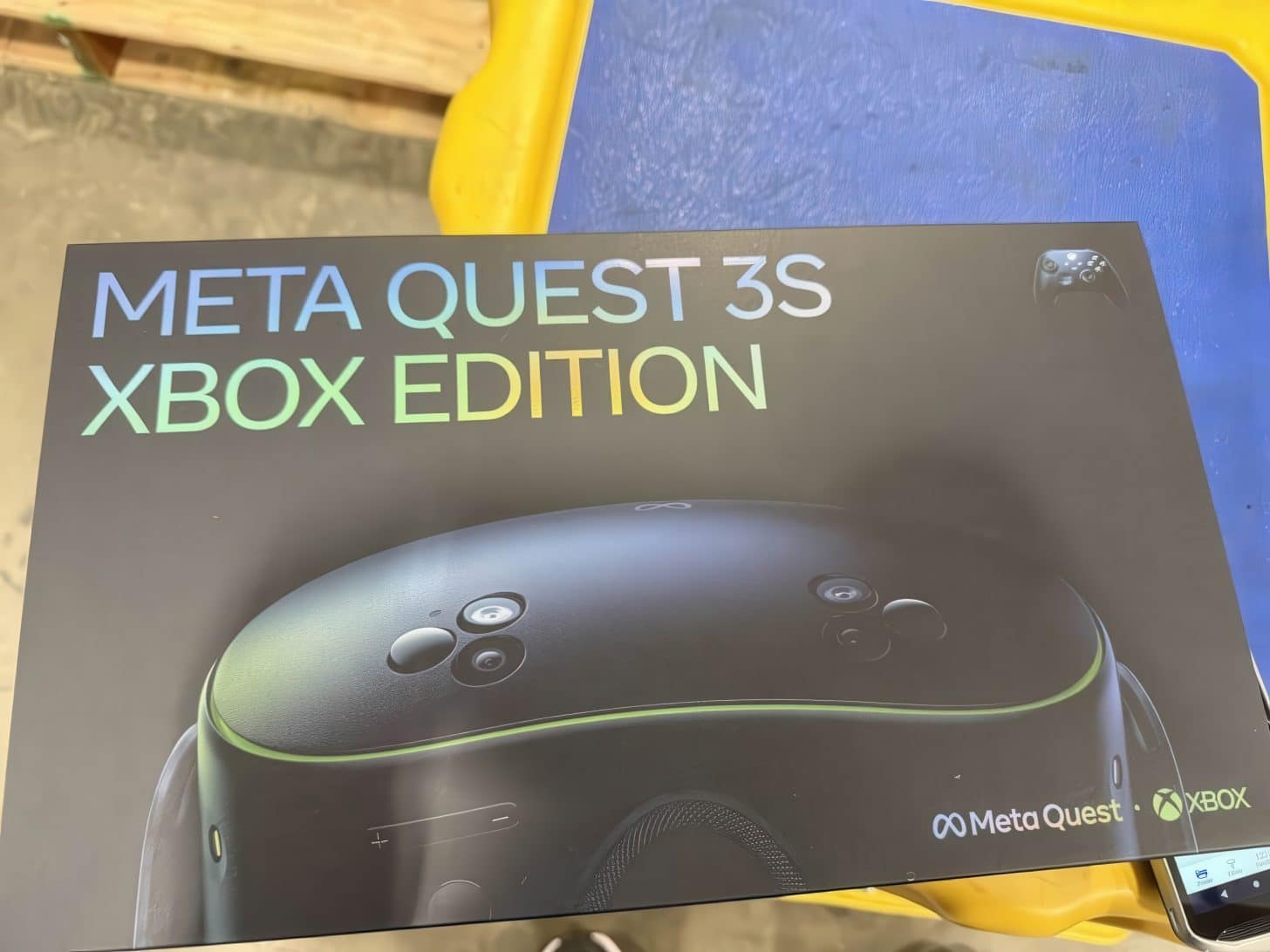
A whisper has turned into a roar across the gaming world: an Xbox-branded virtual reality headset, in collaboration with Meta, appears set to arrive on the market far sooner than many anticipated. Recent leaks, including packaging images and detailed reports, point to a “shadow drop” of a Meta Quest 3S Xbox Edition as early as June 24th, carrying a price tag of $399. This unexpected arrival could mark a significant shift in Xbox’s strategy, embracing accessible VR experiences through partnerships rather than a proprietary, dedicated console VR platform.
Key Takeaways:
- An Xbox-branded Meta Quest 3S headset is rumored for a June 24th launch at $399.
- The headset is expected to bundle an Xbox wireless controller, a Meta Quest Elite strap, and three months of Xbox Game Pass Ultimate.
- This collaboration leverages Meta’s Horizon OS and aims to offer a simplified entry point into VR for Xbox users.
- The headset will primarily focus on Xbox Cloud Gaming on a “big screen” virtual environment, rather than native VR versions of Xbox console games.
- The move signals Xbox’s interest in broader hardware collaborations and a more accessible approach to the VR market.
The leaked information suggests this upcoming device is essentially a re-skinned Meta Quest 3S, featuring a distinct black exterior with green accents, mirroring Xbox’s familiar design language. Crucially, the bundle is reported to include an Xbox wireless controller, a Meta Quest Elite strap, and a generous three-month subscription to Xbox Game Pass Ultimate. This comprehensive package positions the headset as a ready-to-play entry point for those eager to delve into virtual experiences, particularly within the Xbox ecosystem.
A Strategic Alliance: Microsoft and Meta’s Shared Vision
The collaboration between Microsoft, the force behind Xbox, and Meta, a leader in the VR space, is not entirely new. Back in April 2024, Meta announced its intention to license its Horizon OS to third-party manufacturers, with Xbox prominently named as one of the initial partners. Mark Zuckerberg, Meta’s CEO, hinted at the time that Xbox’s involvement would result in a limited-edition Quest headset preloaded with Xbox Cloud Gaming and Game Pass access. The current leaks seem to confirm these earlier pronouncements, showcasing a tangible outcome of that strategic alliance.
This partnership differs significantly from a dedicated Xbox VR console peripheral. Instead of developing a new, high-powered VR headset that directly connects to an Xbox Series X or S, the Meta Quest 3S Xbox Edition leverages Meta’s standalone VR technology. This means the headset operates independently, with the primary focus on streaming Xbox games through Xbox Cloud Gaming onto a large, virtual screen within the VR environment. Users will be able to play hundreds of Xbox titles in a “theater-like” setting, a novel way to experience games without needing a physical television.
It is vital to understand the distinction: this is not a headset designed to bring existing Xbox console games into native VR, allowing players to move through Halo or Forza in a truly immersive 3D space. Instead, it offers a portable, large-screen gaming experience for standard Xbox titles via cloud streaming, alongside access to Meta Quest’s existing library of VR games. This approach allows Xbox to enter the expanding VR market with minimal research and development costs for dedicated VR game titles, while also broadening the reach of Xbox Game Pass.
The Meta Quest 3S: What to Expect from the Hardware
While official specifications for the “Xbox Edition” are yet to be fully confirmed, it is expected to mirror the technical capabilities of the standard Meta Quest 3S. The Meta Quest 3S is positioned as a more accessible option compared to the premium Quest 3. Key features of the Meta Quest 3, which the 3S is expected to largely retain in a slightly scaled-back form, include:
- Display: The Quest 3 boasts 4K+ Infinite Display resolution (2064×2208 pixels per eye) with pancake lenses, offering improved clarity and a wider field of view (110 degrees horizontal and 96 degrees vertical) compared to its predecessor. While the “3S” might have a slightly lower resolution or different display technology to hit a lower price point, it will likely aim for a crisp visual experience.
- Processor: The Meta Quest 3 is powered by the Snapdragon XR2 Gen 2, delivering significant processing power. The Quest 3S is expected to utilize a similar or slightly optimized version to maintain performance for its target experience.
- Storage: The leaked information points to 128GB of internal storage for the Xbox Edition, aligning with the base model of the Quest 3S.
- Mixed Reality Capabilities: The Quest 3 features advanced mixed reality passthrough with dual RGB cameras at 18 PPD for 4.5X better resolution than the Quest 2. This allows users to see their physical surroundings while interacting with virtual objects. The Xbox Edition will likely leverage this for its virtual gaming environments.
- Audio: Integrated stereo speakers with 3D spatial audio are a staple of Quest headsets, placing users in their virtual spaces. A 3.5mm audio jack provides options for external headphones.
- Controllers: The standard Quest 3 comes with Touch Plus Controllers, which feature TruTouch Haptics for realistic feedback. The Xbox Edition, however, is notable for bundling an Xbox wireless controller, emphasizing the cloud gaming aspect. While the Touch Plus controllers might be available separately for native VR games, the inclusion of the Xbox controller underscores the primary use case.
It is important to note that the resolution for streamed Xbox Cloud Gaming titles on Quest headsets is 1080p at 60 frames per second. While not native 4K VR, this resolution provides a clear and smooth experience on a large virtual screen.
Xbox’s Journey into VR: A Historical Perspective
Microsoft and Xbox have had a complex relationship with virtual reality over the years. Unlike Sony, which launched its PlayStation VR in 2016 and followed up with PlayStation VR2 in 2023, Xbox has largely steered clear of a dedicated VR console accessory.
In the early 2010s, Microsoft experimented with augmented reality through HoloLens, focusing more on enterprise and industrial applications rather than consumer gaming. There were also rumors and internal prototypes, like the “Kinect Glasses” for the original Xbox One, but these plans never materialized into consumer products. Phil Spencer, the head of Xbox, has historically expressed skepticism about the “metaverse” as a “poorly built video game,” particularly in the context of corporate meeting rooms. However, his comments often centered on the current state of such applications, not a complete dismissal of immersive technologies for gaming.
This shift towards a partnership with Meta for a co-branded headset represents a more pragmatic and accessible entry into the VR market for Xbox. Instead of investing heavily in developing a new VR hardware platform and a dedicated library of VR games, Xbox is leveraging Meta’s established Quest ecosystem. This strategy allows Xbox to reach a new audience and offer a unique Game Pass experience without the substantial risks associated with launching a new, untested VR platform.
The Broader VR Market and Xbox’s Position
The virtual reality market is currently experiencing dynamic growth, with IDC reporting an 18.1% year-over-year increase in AR/VR headset shipments in the latest quarter. Meta continues to hold a dominant position, capturing 50.8% of the market share. The market is also seeing a clear shift towards mixed reality (MR) and extended reality (ER) experiences, which blend virtual content with the physical world. While pure VR shipments are expected to decline, MR is projected to grow significantly.
Xbox’s entry with the Quest 3S Xbox Edition aligns with this trend, as the Quest line offers robust mixed reality capabilities. By providing a familiar gaming ecosystem (Xbox Game Pass) within a versatile VR/MR headset, Xbox aims to attract both existing console gamers and new users looking for a convenient entry point into immersive technology.
The bundling of an Xbox controller with the headset is a clear signal of intent: the primary focus is on expanding the reach of Xbox Cloud Gaming into the VR space, rather than competing directly with platforms that offer deeply immersive, native VR game libraries. This approach allows Xbox to capitalize on its vast library of existing games, making them accessible in a new format.
Public Reception and Future Prospects
Initial reactions from the gaming community have been mixed but generally positive, acknowledging the strategic value of the partnership. While some had hoped for a full-fledged Xbox VR headset capable of running AAA VR titles natively, the focus on cloud gaming for a “big screen” experience is seen as a practical and appealing alternative. The $399 price point, especially with the included accessories and Game Pass subscription, makes it an attractive proposition for many. For those who already own a Meta Quest headset, the existing Xbox app on the Quest platform already allows for Xbox Cloud Gaming. However, the dedicated Xbox branding and bundled accessories aim to streamline the experience for newcomers and Xbox loyalists.
This move could pave the way for deeper integration between Xbox and Meta’s platforms in the future. As VR and mixed reality technologies continue to evolve, and as cloud gaming infrastructure becomes more robust, the potential for truly immersive Xbox experiences within the Meta ecosystem could expand. For now, the imminent release of the Meta Quest 3S Xbox Edition represents a clear step by Xbox to embrace the future of interactive entertainment on its own terms, by focusing on collaboration and accessibility.
Frequently Asked Questions (FAQ)
Q1: What is the Xbox-branded Meta Quest 3S headset?
A1: It is a rumored special edition of Meta’s standalone VR headset, the Quest 3S, featuring Xbox branding, designed to offer Xbox Cloud Gaming on a virtual big screen, and potentially bundling an Xbox controller and Game Pass.
Q2: When is the Xbox VR headset expected to be released?
A2: Leaks suggest a “shadow drop” release date of June 24th.
Q3: How much will the Xbox Meta Quest 3S cost?
A3: The rumored price is $399.
Q4: Will I be able to play existing Xbox console games in native VR with this headset?
A4: No, the primary focus is on streaming standard Xbox games via Xbox Cloud Gaming onto a large virtual screen within the VR environment. It is not designed to run native VR versions of Xbox console games.
Q5: What is included with the Xbox-branded Meta Quest 3S?
A5: Reports indicate it will include the Meta Quest 3S headset, an Xbox wireless controller, a Meta Quest Elite strap, and three months of Xbox Game Pass Ultimate.
Q6: What are the key specifications of the Meta Quest 3S?
A6: While specific “3S” specs are not fully detailed, it is based on the Meta Quest 3, which features a Snapdragon XR2 Gen 2 processor, 4K+ Infinite Display (2064×2208 pixels per eye), pancake lenses, and mixed reality capabilities. The Xbox Edition is expected to have 128GB of storage.
Q7: Do I need an Xbox console to use this VR headset?
A7: No, the headset operates as a standalone device. Xbox Cloud Gaming functionality relies on an Xbox Game Pass Ultimate subscription and a high-speed internet connection, not a physical Xbox console.
Q8: Can I play other VR games available on the Meta Quest platform with this headset?
A8: Yes, as it is a Meta Quest headset, it will likely support the existing library of VR games available on the Meta Horizon Store.
Q9: Why is Xbox partnering with Meta for VR instead of making its own VR headset?
A9: This partnership allows Xbox to enter the growing VR market with less research and development investment by leveraging Meta’s established hardware and software platform, while focusing on expanding Xbox Game Pass access.
Q10: What kind of experience can I expect when playing Xbox games on this headset?
A10: You will experience Xbox games streamed at 1080p resolution and 60 frames per second on a large, virtual screen, similar to a private theater. You can also play in an Xbox-themed virtual environment.